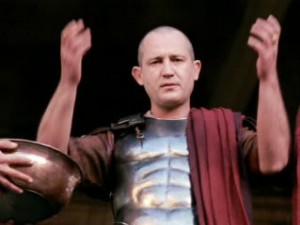
Pilate washed his hands

Click for source

The trial of Jesus has everything backwards.  The Judge of the world is in the dock.  The Truth is cross-examined.   The Righteous One is pronounced guilty.

As we saw last time, the people act as judge and jury, while at times Pilate seems more like a public defender.  Now in this verse, the Governor seeks to abdicate all governance.

“When Pilate saw that he could prevail nothing, but that rather a tumult was made, he took water, and washed his hands before the multitude, saying, I am innocent of the blood of this just person: see ye to it.”  (Matthew 27:24)

During the Nuremberg trials, many Nazis sought to blame those higher up in the chain of command for their crimes.  Pilate does the reverse – blaming the people for a decision that lay ultimately at his door.  It is ironic that Pontius Pilate is known for two things today.  He was the original ‘washer of his hands’ over a matter for which he felt himself innocent.  Yet at the same time he is remembered every Sunday by millions all over the world as the murderer of Jesus:

…Crucified under Pontius Pilate… (From both the Apostles and the Nicene Creed).

No-one is innocent of Christ’s blood.  Neither the Jews nor the Gentiles, neither the masses nor the rulers.  We can perform as many rituals as we like, but we all have blood on our hands.

Yet, amazingly, this is where Christ meets us.  You see in the Old Testament tabernacle (and then Temple) there was a basin erected next to the altar.  Many times it is commanded that the sacrifices are to be washed before they are slain.  Yet in connection with this basin, only one kind of washing is commanded.  This basin was for the High Priest, to wash his hands (Exodus 30:18f).  The one who offers up the sacrifice must show his ceremonial cleanness to the people.

No doubt Pilate was unaware of this detail and yet he fulfilled it publicly.  The Lamb of God would be sacrificed according to the law, and the man responsible would wash his hands for all to see.  Yet such an act does not vindicate Pilate, it vindicates Christ who, though silent like a sheep before its shearers, seems to be pulling the strings in a remarkable way.

For those viewing these events politically, they inspire only cynicism.  Pilate is trying to absolve himself, when he should be taking responsibility.  For those viewing these events biblically, they inspire deep trust.  Even as He suffers the most cosmic miscarriage of justice, Christ remains in control.  The condemned Man is convicting the world.  The One in the dock is calling the shots.  “The Son of man goeth as it is written of Him.”  (Matthew 26:24).  And His killers only end up serving His purposes.

Crucify Him, Crucify Him

Click for source

In 1963, Stanley Milgram’s experiment asked anonymous participants to deliver increasingly severe electric shocks to subjects in the next room.  Unbeknownst to the participants, the shocks were not real.  But had they been, they may have been fatal.  The great majority of participants delivered the shocks, even though there were screams of great pain from the next room.

In 1971, Philip Zimbardo ran the Stanford Prison Experiment in which participants were divided into guards and prisoners.  The guards were given uniforms and had authority over the ‘prisoners’.  The two week experiment had to be abandoned after 6 days because of rampant abuse of power on the part of the guards.  Zimbardo’s book on the subject was called “The Lucifer Effect.”

Something happens when people lose their individual identities in the crowd, when there seem to be no consequences, when they act en masse , when there is a diffusion of responsibility such that there’s always someone else to carry the can.

There was a very definite “Lucifer effect” when Pilate addressed the people during the trial of Jesus.  There was a custom of releasing a prisoner at the feast of Passover.  Pilate suggests that it’s Jesus who is released.  The crowd seem to prefer having a murderer roam free among them…

18 And they cried out all at once, saying, Away with this man [Jesus], and release unto us Barabbas: 19 (Who for a certain sedition made in the city, and for murder, was cast into prison.) 20 Pilate therefore, willing to release Jesus, spake again to them. 21 But they cried, saying, Crucify him, crucify him. 22 And he said unto them the third time, Why, what evil hath he done? I have found no cause of death in him: I will therefore chastise him, and let him go. 23 And they were instant with loud voices, requiring that he might be crucified. And the voices of them and of the chief priests prevailed. 24 And Pilate gave sentence that it should be as they required. 25 And he released unto them him that for sedition and murder was cast into prison, whom they had desired; but he delivered Jesus to their will.

This was a Passover crowd – drawn from the four corners of Israel.  It’s highly likely that many in the crowd had been personally healed by Jesus in the last three years.  Certainly a good number would have heard His teaching, seen His miracles and known people whose lives had been transformed by Jesus.  And yet, you can feel the electricity crackling among the people, “Crucify him! Crucify him!”

On Palm Sunday many churches have a tradition of dramatizing the passion narrative, with the congregation taking on the role of “the crowd.”  The readings always made a huge impact on me as a child.  But this line more than any other shook me.  It was always the loudest part of an otherwise sombre service.  And there we were, church people, and we were baying for the blood of Jesus.  Imagine actually being in this crowd.  They are the people of God and the Messiah’s fate lies in their hands.  They bay for His blood, even though they don’t really know why.  Pilate asks them, but they have no answer.  They just seem driven along this mad path to Deicide.

There are no reasons for putting the Son of God to death.  There is only this primeval urge in the crowd – He must be done away with.  This is our sinful condition expressed in its clearest terms.  We would rather have a murderer released among us than the Lord of life!

But even in the midst of our terrible sin, a wonderful gospel presentation is seen.  Barabbas is a name that means “Son of his father”.  He is a counterpart to Jesus.  A son of a different father whose unrighteousness reveals a different origin.  Here is Adam’s son – one very much under Lucifer’s effect – he who had been a murderer from the beginning.  But on this day, in a very real and literal way, Jesus died for him.  Jesus, the Inncoent, died in the place of Barabbas, the guilty.

And if Barabbas had dared to walk up to Golgotha on that Friday he could have pointed to the middle cross and said “That should have been me.  But Jesus died in my place.”

Here is the hope for all the sons and daughters of Adam.  Here is the hope for all of us who fall under Lucifer’s effect.  Christ’s death was not merely the will of the people (v25).  It was His own will.  The cross is not simply the proof of our sinfulness, but the offer of His salvation.  His incredible love means that He wants to die for devils like Barabbas, and devils like you and me.  Therefore we too can point to the cross – the cross that we have bayed for! – and declare with wonder:

The Son of God loved me and gave Himself for me.  (Galatians 2:20)

My kingdom is not of this world

Click for source

The myth of violence powerfully shapes our view of the world.  We imagine that force must be met with greater force if anything will be achieved.  And of course we tell ourselves that the greater force is justified if it’s done in the name of some greater good.  Most Hollywood blockbusters follows this storyline.

Take, for instance, the highest grossing film of all time.  Avatar tells the story of a culture clash between greedy imperialists and a nature-loving indigenous people.  Yet however different the natives might be portrayed, how do they overcome the nasty invaders?  A loud and lengthy slug-fest.  In a spectacular special-effects battle, the biggest hitters win.  And so a wonderfully imaginative beginning concludes with a predictably bloody finale.  And on the deepest level it’s neither the imperialists nor the natives who win.  In the end, violence wins.

The trial of Jesus might look like one more clash between powers.  Facing off are two contenders for the title: King of the Jews.  But this encounter will subvert everything we know about power struggles.

Pilate claims to rule the Jews as the vice-regent of Rome.  Christ claims to rule the Jews as the Vice-Regent of God!  But this is not simply a clash of kings, it’s a clash of the kind of power by which they rule:

33 Then Pilate entered into the judgment hall again, and called Jesus, and said unto him, Art thou the King of the Jews? 34 Jesus answered him, Sayest thou this thing of thyself, or did others tell it thee of me? 35 Pilate answered, Am I a Jew? Thine own nation and the chief priests have delivered thee unto me: what hast thou done? 36 Jesus answered, My kingdom is not of this world: if my kingdom were of this world, then would my servants fight, that I should not be delivered to the Jews: but now is my kingdom not from hence.

Pilate rules the way every human rules – with the sword.  His servants do indeed fight for him.  Pilate has the monopoly of violence in his province.  He decides who can wield physical force and who cannot.  If you cross him, he’ll cross you – literally.  He’ll line the streets with crosses if needs be.  And if anyone were to usurp his rule it would be by bringing more earthly power.  Force would unseat force.  And yet even if that occurred, there’s one thing that would remain on the throne – force!

But Jesus hasn’t come by force to effect a slightly more benevolent reign of violence.  Jesus has come to unseat violence itself.  His kingdom is not of this world.  The kings of this world ask their servants to fight for them.  Jesus subverts this kind of kingdom in two ways.  First He fights for them.  Second, the way He fights is by losing.  He ends the cycle of violence by taking the blows and not retaliating.

Here is the cruciform revolution that Jesus brings to the world.  The Apostle Paul, reflecting on the meaning of the cross, said this:

The foolishness of God is wiser than men; and the weakness of God is stronger than men. 26For ye see your calling, brethren, how that not many wise men after the flesh, not many mighty, not many noble, are called: But God hath chosen the foolish things of the world to confound the wise; and God hath chosen the weak things of the world to confound the things which are mighty;  And base things of the world, and things which are despised, hath God chosen, yea, and things which are not, to bring to nought things that are: (1 Corinthians 1:25-28)

How does God overcome strength?  With weakness!  It’s absolutely counter-intuitive but two minute’s thought reveals its wisdom.  Power-plays are not overcome by a show of force!  They can only be unseated by the cross.  The Lord of Glory undermines all earthly glory by descending beneath it.  And through the cross, Christ establishes a kingdom of servants not fighters.  Won by His cross, we are called not to kill but to be killed, not to over-power with force, but to over-whelm with love.  The spreading of Christ’s reign ought to look completely different to the spread of any earthly kingdom.  It should look like a base and despised people pointing to a weak and foolish Victim.  But this is how we confound the mighty.  It is the triumph of grace.

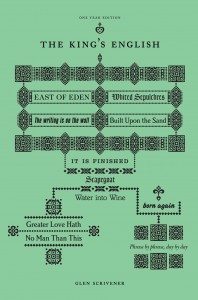
Why do atheists love the King James Bible?

That’s one of the topics for discussion at the Battle of Ideas 2011.  Tomorrow afternoon, 5:30pm at the Royal College of Art.

Elizabeth Hunter the director of Theos, a public theology think-tank will be the Christian voice on a panel including Andrew Copson, Chief Executive of the British Humanist Association.

Find out more here. including a very useful set of links to further reading.

I’ve spoken elsewhere about Dawkins’ love for the KJB and how ridiculous it is that he thinks “religion” has “hijacked” it.

Something else that occurs to me is this.  The triumph of a Bible in the vernacular was at the heart of the English renaissance.  What it did was to put the word at the heart of worship instead of images.  Very crudely put, words are a matter of truth, and images a matter of beauty (obviously words can be beautiful (as we’ll see) and images very meaningful – but let’s work with this crass generalisation for now).  Words provoke the intellect, images excite the senses.  Images without words keep people enslaved to the interpretations of the establishment.  Power is kept when images are at the centre.  But words written in the language of the people devolves power.  This was the revolutionary thing.  But it was revolutionary because the words conveyed ideas – and those ideas were liberating.

When it is understood that the Lord of all became a servant (or in the King James Version, a “minister”) then your understanding of earthly power is transformed.  The most powerful needs to be the prime minister – the chief servant.

When it is understood that the Ruler of heaven reigns as Man and even because He is now Man, then you start to believe that government should be “of the people, for the people and by the people.”  (That sentiment was first expressed in John Wycliffe’s preface to the Bible!).

When it is understood that the Logic of all creation took flesh and was seen, handled, tested and known, then you start to study the world in a new way.  The Word who became flesh leads you to expect both Laws and empirical testing to discover those laws.  If you only believe in “laws” you will create philosophers.  If you only believe in “empirical testing” you will create technology.  But for the modern scientific method you need both.  Without the Biblical worldview it is inconceivable that science as we know it could have arisen.

When it is understood that God’s riches – His grace – should not be paid back to God (as though He needs anything) but freely paid forwards to our fellow man, then you begin having a different view of earthly riches.  Freed by God’s grace you stop hoarding or displaying your wealth and start paying it forwards, re-investing it.  And you begin to realize the truth of Christ’s words “freely you have received, freely give.”  Free grace gives rise to free markets.

Therefore it is no wonder that atheists should love the King James Bible.  In so many spheres of modern life it was the understanding of the Bible that unleashed incredible human flourishing.  This word has made our modern world and we cannot understand our world without understanding this book.

But here’s the irony, and partly the King James Translation is to blame.  If the beauty of the Bible becomes our focus then we begin to commit the errors of the medieval church.  If we simply praise the style without dealing with the content, then we miss the real power of the book.  I say that the King James Translation is partly to blame.  This is because it was born archaic.  It was based on the Bishop’s Bible which itself, one way or another, was based on Tyndale’s translation from almost a century earlier.  While Tyndale translated for the plough-boy, the KJV was translated to be read aloud in worship, and beauty was uppermost in the translator’s thinking.

Of course there’s nothing wrong with beauty!  And many parts of the Scriptures are very beautiful indeed, and meant to be so (think of the Hebrew poetry of the Psalms).  But much of the Bible is rough and ready and written in the Koine Greek of the marketplace.  Yet the KJV renders the whole of it in measured and dignified cadences.  This is not a problem for a 17th century church service, but for a 21st century reader it doesn’t always allow the same degree of understanding that could really unleash the power of the Bible.

A love for the King James Bible should not stop at its lyrical beauty.  If it does it betrays the real revolutionary power which the English Bible unleashed in the 16th and 17th centuries.  The English renaissance was birthed out of the content of the Bible – the gospel of Jesus Christ.  And if we want another renaissance, that’s the place we’ll find it!

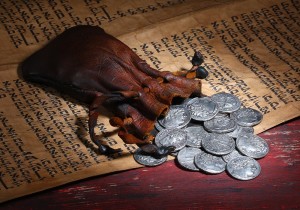
Thirty pieces of silver

Click for source

What would motivate Judas to betray the Son of God?  Theories abound.  Many reconstruct a supposed political radicalism.  Perhaps he was disenchanted by Christ’s non-violence.  Judas, we imagine, had been hoping for an uprising and was so disappointed by Christ’s way of peace that he sold Him out.

That’s a fascinating supposition.  But it’s both groundless and redundant.  The Bible tells us exactly why Judas betrayed Jesus:

“Then one of the twelve, called Judas Iscariot, went unto the chief priests, And said unto them, What will ye give me, and I will deliver him unto you? And they covenanted with him for thirty pieces of silver. And from that time he sought opportunity to betray him.”  (Matthew 26:14-16)

Judas loved money.  John 12:6 puts it starkly, “he was a thief”.

If that doesn’t sound sensational enough as a motive, perhaps we have misunderstood Christ’s teaching on money:

According to Jesus, we either serve God or money (i.e. mammon).  We either look to the living God or we seek the resources of this world.  Of course, with judgement coming we would be a fool to pursue an abundance of possessions.  But such fools we are by nature.  And our foolish hearts are revealed by our foolish investments in earthly treasure.  (“Where your treasure is there you heart shall be also“).

Therefore, as mad as it is to value the Son of God at 30 pieces of silver, this is precisely the motive we should expect from Judas.

But what is the meaning of this price?

Centuries earlier, the prophet Zechariah was given thirty pieces of silver – this was the price he was “prised at”. (Zechariah 13:13).  Though he calls it a “goodly price” he is perhaps being ironic.  All he does with this valuation is to throw the money into the house of the LORD where “the potter” would receive it.  His feelings are understandable when we remember the legal significance of “thirty pieces of silver”.

In Exodus 21 there are rules concerning the keeping of dangerous animals.  If you have been negligent and let out an ox who kills a servant then your own life is forfeit.  You ought to die but you can ransom yourself from death by paying thirty pieces of silver.  In so doing, you, the guilty one, are redeemed and the servant is valued.

Therefore 30 pieces of silver is the value placed on a servant’s life, it’s an offensively meagre price for a prophet and it provides redemption for the sinner.  In all this we see how fitting it is that this was the amount of blood money paid to Judas.  Jesus is the Servant of the LORD, slain at the hands of the beast.  He is the Prophet, misunderstood and undervalued by His people, but prized by the Potter.  And He is the ransom price offered for we the guilty.  A ransom, infinitely more precious than silver or gold:

Ye know that ye were not redeemed with corruptible things, as silver and gold, from your vain conversation…  But with the precious blood of Christ, as of a lamb without blemish and without spot  (1 Peter 1:18-19)

Betrayed with a kiss

Click for source

If ever there was a man who could call himself the elect of the elect, it was Judas.

He was not only Jewish, he was, in all probability, from the tribe of Judah.  Certainly his name means “Judah” – which refers not simply to the southern kingdom of Israel but also to the royal tribe from which Christ Himself was descended.  Here was Jesus’ own kith and kin.  This alone would make him the elect of the elect.

Yet Judas’s privileges go even deeper.  The Scriptures constantly present him as a close friend of Christ’s (Psalm 41:9; 55:12-13; John 13:18-30).  He had not only seen the mighty works of Christ, he had performed them too, in Jesus’ name (Luke 9:1ff).  And, of course, he was one of the twelve.  Even more, he was chosen as treasurer of the group (John 12:6).  In that sense he was the elect of the elect of the elect of the elect.

And yet here is what this chosen one does to the Eternally Chosen One:

While Jesus yet spake, behold a multitude, and he that was called Judas, one of the twelve, went before them, and drew near unto Jesus to kiss him.  But Jesus said unto him, Judas, betrayest thou the Son of man with a kiss?  (Luke 22:47-48)

Just hours earlier Jesus had bent down and washed his feet, then fed him, sacramentally, with His own body and blood.  Jesus had only ever done Judas good.  Yet now He is betrayed.  And betrayed with a kiss.

Biblically speaking, a kiss is not only a sign of intimacy and friendship, it’s also an act of worship.  One of the key biblical words for worship (proskuneo) literally means to “kiss towards.”  Therefore think of Psalm 2 where the kings of the earth are commanded to “worship the LORD” and, in the same breath, to “Kiss the Son” (Psalm 2:10-12).  So here is a literal kissing of the Son by a royal Judah-ite.  This should be the essence of worship, in fact it’s the height of treason.

And this is the Bible’s picture of humanity.  It was Judas, the elect of the elect, who betrays Jesus.  And betrays Him to the best of the best – the Jewish establishment.  And they, with the help of the mightiest of the mighty (the Romans) crucify the Lord of Glory.

Humanity does not stand with Jesus in His work.  No-one gives Jesus a helping hand when He saves the world.  Simon “the rock” fails, deserts and denies Him.  Judah himself betrays Him.  And the children of Abraham sentence Him to death.  The best that humanity has to offer is not an aid to Jesus – we only cause His death.  And the more we lay claim to strength, wisdom and righteousness, the more complicit we seem to be in His murder.  It wasn’t the worst of humanity that slew the Son of God – it was the best.

This scene shows the truth so starkly: From the outside we see a respectable man of good breeding worshipping the LORD.  In fact it’s the very betrayal of God.  When it comes to salvation, humanity only stands in the way of the LORD.  And the very best of humanity, appearing with the best of intentions, proves utterly traitorous.

The Spirit is willing, the flesh is weak

Praying at Gethsemane by He Qi - Click for link

My teenage years were haunted by Gethsemane.  For a serious-minded 14 year old, this was the ultimate display of godly devotion.  Here was Christ leading the way in the school of prayer – showing us how to “give it all up for God.”  In desperation He prostrates Himself before the Father, He pours out His soul, He offers everything to God no matter the cost and declares “thy will be done!”

Well then, what’s a good Christian boy to do but follow in His footsteps?  So that’s what I tried.  Night after night, year after year I prayed what I considered to be “Gethsemane prayers.”  “God take me, use me, come into my life, have it all, your will be done!

I expected heaven to open, or perhaps angels to attend me.  At least a funny feeling in my stomach, some sign that I’d been heard.  But I got nothing.  So I prayed again.  This time more fervently.  Still nothing.  So I decided to pull out all the stops.  I went outside at dead of night, the way Jesus did.  I would find the scariest clearing in a forest and fall prostrate before God: “Take me, use me, your will be done!”  And the response from heaven?  Nothing.

After a thousand of such prayers I came to the conclusion that God didn’t want me.  So I didn’t want Him.  I left home to have as good a time as possible without Him.

Yet a few years later the Lord brought me back through this same passage.  You see I had forgotten how Matthew 26 ends:

“40 And Jesus cometh unto the disciples, and findeth them asleep, and saith unto Peter, What, could ye not watch with me one hour? 41 Watch and pray, that ye enter not into temptation: the spirit indeed is willing, but the flesh is weak. 42 He went away again the second time, and prayed, saying, O my Father, if this cup may not pass away from me, except I drink it, thy will be done. 43 And he came and found them asleep again: for their eyes were heavy. 44 And he left them, and went away again, and prayed the third time, saying the same words. 45 Then cometh he to his disciples, and saith unto them, Sleep on now, and take your rest: behold, the hour is at hand, and the Son of man is betrayed into the hands of sinners. 46 Rise, let us be going: behold, he is at hand that doth betray me.”  (Matthew 26:40-46)

Our Bible study came to Matthew 26 and I expressed how daunted I was by Gethsemane.

“Daunted? Why?” asked the leader.

“Well,” I replied, “I just don’t think I can pray Gethsemane prayers the way Jesus did.  I don’t have that level of commitment.”

“The way Jesus did?  Glen, who do you think you are in this story?”

I didn’t like to say but, well, surely I’m Jesus in the story.  Or I’m meant to be anyway.

The leader corrected me.  “Do you know who you are?  You’re Peter.”

And the penny dropped.  I’m not Jesus!  I’m Peter.  I’m weak, useless, faithless Peter.  I ought to pray with Jesus, but I don’t.  I fail.  And as I fail, Jesus prays for me.

By the Spirit, I belong to Jesus.  By the Spirit I want to follow Christ.  But my flesh is from Adam.  My flesh is weak.  And I’m constantly falling asleep on the watch.

But Jesus prays for me.

That’s the meaning of this story.  It’s the meaning of the Scriptures.  I am not the centre, Christ is.  I am not the Faithful, Obedient One, Christ is.  My hope is not my self-offering to God.  My hope is Christ’s self-offering to God.  And while I sleep and fail and flee and even deny Him – Christ is praying for me.

Christopher Idle put it perfectly:

When you prayed beneath the trees, it was for me, O Lord;
When you cried upon your knees, how could it be, O Lord?
When in blood and sweat and tears, you dismissed your final fears,
When you faced the soldier’s spears, you stood for me, O Lord.

When their triumph looked complete, it was for me, O Lord,
When it seemed like your defeat, they could not see, O Lord!
When you faced the mob alone, you were silent as a stone,
And a tree became your throne; you came for me, O Lord.

When you stumbled up the road, you walked for me, O Lord,
When you took your deadly load, that heavy tree, O Lord;
When they lifted you on high, and they nailed you up to die,
And when darkness filled the sky, it was for me, O Lord.

When you spoke with kingly power it was for me O Lord
in that dread and destined hour you made me free O Lord
Earth and heaven heard you shout, death and hell were put to rout
For the grave could not hold out; you are for me O Lord


Let this cup pass from me

Click for source

It was the original poisoned chalice.  Just minutes after pouring wine into a cup of blessing, Jesus prays to His Abba, Father regarding a very different cup:

“Then cometh Jesus with them unto a place called Gethsemane, and saith unto the disciples, Sit ye here, while I go and pray yonder. And he took with him Peter and the two sons of Zebedee, and began to be sorrowful and very heavy. Then saith he unto them, My soul is exceeding sorrowful, even unto death: tarry ye here, and watch with me. And he went a little farther, and fell on his face, and prayed, saying, O my Father, if it be possible, let this cup pass from me: nevertheless not as I will, but as thou wilt.” (Matthew 26:36-39)

Between these two cups we learn something of the “wonderful exchange” which takes place between Christ and the believer.

One cup was offered in the upper room.  One cup was offered in the Garden of Gethsemane.

One cup is given to us.  One cup Jesus drinks for Himself

One cup is for the forgiveness of sins.  One cup is full of wrath and judgement.

One cup brings life.  One cup brings death.

One cup is described as a cup of blessing.  The other cup is a cup of curse.

Yet Jesus takes the curses that we might have the blessings.  He drinks what we deserve so that we receive what only He deserves.

And though this exchange is offered for free.  It is unfathomably costly for Christ.

Consider how the bible speaks of this cup of judgement:

In the hand of the LORD there is a cup, and the wine is red; it is full of mixture; and he poureth out of the same: but the dregs thereof, all the wicked of the earth shall wring them out, and drink them.  (Psalm 75:8)

Thus saith the LORD God of Israel unto me; Take the wine cup of this fury at my hand, and cause all the nations, to whom I send thee, to drink it. And they shall drink, and be moved, and be mad, because of the sword that I will send among them.  Then took I the cup at the LORD’s hand, and made all the nations to drink, unto whom the LORD had sent me… Therefore thou shalt say unto them, Thus saith the LORD of hosts, the God of Israel; Drink ye, and be drunken, and spue, and fall, and rise no more, because of the sword which I will send among you.  And it shall be, if they refuse to take the cup at thine hand to drink, then shalt thou say unto them, Thus saith the LORD of hosts; Ye shall certainly drink.  For, lo, I begin to bring evil on the city which is called by my name, and should ye be utterly unpunished? Ye shall not be unpunished: for I will call for a sword upon all the inhabitants of the earth, saith the LORD of hosts.  (Jeremiah 25:15-29)

If any man worship the beast and his image, and receive his mark in his forehead, or in his hand, The same shall drink of the wine of the wrath of God, which is poured out without mixture into the cup of his indignation; and he shall be tormented with fire and brimstone in the presence of the holy angels, and in the presence of the Lamb.  (Revelation 14:9-10)

This is why Jesus was “exceeding sorrowful, even unto death.”  This is why He asks for the cup to pass from Him.  This is why Luke’s gospel records that “his sweat was as it were great drops of blood falling down to the ground.”  (Luke 22:44).  Blood vessels are bursting all over His body as He contemplates drinking this cup.  It is full of the furious wrath of God.

The cross is not a three-hour inconvenience for the Son of God.  It means entering into the infinite abyss of sin and curse.  The hell of the cross was not easier for Christ than the hell of the damned.  The hell of the cross was worse.  All hell was distilled in that cup.  All hell converged on that cross.  And for the holy Son of God it was not more bearable but infinitely worse.  Therefore He wanted another way.  Of course He prays that the cup might pass.

And yet, how strange that He should pray it.  Here is the Lamb slain from the foundation of the world (Revelation 13:8). But as that dreaded hour draws near, He seeks earnestly for another path.  How terrible is the godforsakenness of the cross!  And yet how necessary.

Often people question the necessity of the cross.  Why should Christ have to die?  Why doesn’t God simply forgive?  Why this business with blood sacrifice?  Surely there’s another way!?

These are all questions which, in principle, Christ Himself asks here in the garden.  This is the very essence of His hour-long wrestling.  And yet His Abba, Father provides no other way.  There is no cup of blessing for us unless Christ takes the cup of curse.  We cannot escape from the furnace of judgement unless Christ goes for us.  The cup of wrath cannot pass from us unless it passes to Christ.

And here in the garden, Man steps in for man.  Where Adam had failed in that first garden, Christ triumphs.  He rises from prayer resolved “Thy will be done!” (v39).  He has faced the prospect in all it’s horror – either He goes to hell or we do.  And He comes to His decision:  “Father, let it be me!”

Amazing love, how can it be?
That Thou my God shouldst die for me!

Abba, Father

Click for source

It’s one of the first sounds a baby will make.  ‘Ma ma ma ma’.  Or ‘Ba ba ba ba’.  Which is why, in so many languages, the proud parents take their babbling children to be speaking their names.  ‘Mama’ or ‘Amma’ is a very common word for ‘mother’.  And ‘Papa’ or ‘Baba’ is similarly common as a word for father.  In Aramaic it’s “Abba” which a child will call their father from the very earliest age.

Yet the name is not only reserved for childhood (as “Daddy” might be in English).  The toddler who cries “Abba”, will continue to call their father “Abba” long into adulthood.  It is not only an intimate term, but one of respect.

But here’s the question: Who gets to call God Most High “Abba”?

If I called the Queen “Liz” that would be a gross dishonour, but at least such familiarity makes no claim on the Queen.  I have no right to call her “Liz” but in doing so I haven’t established any claim to her throne or right to protection or provision.  “Liz” is intimate but it doesn’t set me in a particular relationship to her.  But if I claim to be family, that’s something else entirely.  If the Queen were not only Ma’am but also Mum, that would put me in a very privileged position.  As family I am in on what she is in on.  As family I can inherit.

So let’s return to our question: Who gets to call God Most High “Abba”?  Answer: the Son of  God.  And, really, only Him.  Only Jesus can articulate that degree of intimacy.  Only Jesus can make that kind of claim on the God of Heaven.

In the New Testament we read three “Abba, Father”s.  The first is in the garden of Gethsemane (of which, more tomorrow).  There Jesus prays in blood earnestness to His Father as He contemplates the cross.  The obedient Son call out to the Father with a title that only the obedient Son can.

And yet, the phrase is used twice more by the Apostle Paul.

In Galatians 4:6 he writes:

God hath sent forth the Spirit of his Son into your hearts, crying, Abba, Father.  (Galatians 4:6)

Here we see the Spirit sweeping up the believer into the perfect prayer-life of the Son.  The Spirit of Christ prays Christ’s prayer in us and through us.  We are drawn by the Spirit into the union and communion which the obedient Son enjoys with His Abba, Father.  The believer’s new heart-beat is “Abba, Father, Abba, Father, Abba, Father” because the Spirit is making that cry from deep within us.

But not only this, Romans 8:15 says:

ye have received the Spirit of adoption, whereby we cry, Abba, Father.

“Abba, Father” is no longer just what the Son prays.  And it’s not just what the Spirit of the Son prays in us.  The Spirit now teaches us to pray “Abba, Father” for ourselves.

What right do we have to call the King of Kings “Daddy”?  None.  Not in ourselves.  But Christ has that right.  And by His Spirit, He shares that right with us.

As Mike Reeves has said:  “To be the son of a millionaire would be nice.  To be the firstborn of some wealthy king would be wonderful enough.  But we are the beloved children of the Emporer of the Universe.”  And we can call Him “Abba, Father.”

Behold, what manner of love the Father hath bestowed upon us, that we should be called the sons of God  (1 John 3:1)

This is my blood

Click for source

In 2 Thessalonians 2, the Apostle Paul speaks of “the lie.”  It’s a deception which the human race falls for every time.  Essentially the lie is this: We believe that the Lord is grudging.  We imagine that, if He’s gracious at all, He doles out blessings with a teaspoon.

Ever since Satan first spoke to Eve he has been peddling this same deception: “You mean to tell me God’s withholding all this fruit from you?  What a miser!”  Eve fell for it.  Adam fell for it.  The world falls for it.  Every day.  And so do I.

The greatest battle in my Christian life is to fight “the lie.”  Because every day I am tempted to view God as a distant, tight-fisted, kill-joy.  It makes me mistrust Him, shut down and close off from Him.  Then I try to manage life out of my own resources.  This lie will kill my spiritual life.

So how should I fight the lie?  With the blood of Christ.

After handing out bread at the last supper…

Jesus took the cup, and gave thanks, and gave it to them, saying, Drink ye all of it; For this is my blood of the new testament, which is shed for many for the remission of sins.  (Matthew 27-28)

It’s a shocking dramatization of the cross.  Bread torn apart – this is my body. Red wine poured out – this is my blood.  Jesus would be utterly consumed and exhausted on the cross.  Broken and expended… for us.  That’s the whole point – it’s for us.  Jesus takes death, we get the feast.  He gives His blood, we get the banquet.

And just think of what blood means in the Bible.  In Leviticus 17 the LORD speaks of the blood of the sacrifices:

The life of the flesh is in the blood: and I have given it to you upon the altar to make an atonement for your souls: for it is the blood that maketh an atonement for the soul. (Leviticus 17:11)

To pour out blood is to pour out life.  And this is what Jesus does for us.  He gives His infinitely precious blood – the blood of God (Acts 20:28) – in atonement for our souls.

Who can look to the cross and doubt the generosity of our Lord?  Here is no grudging miser.  Here is Life expended to the very last drop.  Here is a gushing forth of self that we might live.

This God does not dispense blessings with a teaspoon.  He pours Himself out – for us and to us.  At the cross, ‘the lie’ is unmasked.  Satan is the miser.  We are the selfish ones.  God is Giver – though it cost Him everything.  And He doesn’t merely give us things, He pours out His own blood.  He expends Himself in complete self-offering.  And all we can do is gratefully receive.

When I Survey The Wondrous Cross Hymn
When I survey the wondrous cross
On which the Prince of glory died,
My richest gain I count but loss,
And pour contempt on all my pride.

Forbid it, Lord, that I should boast,
Save in the death of Christ my God!
All the vain things that charm me most,
I sacrifice them to His blood.

See from His head, His hands, His feet,
Sorrow and love flow mingled down!
Did eer such love and sorrow meet,
Or thorns compose so rich a crown?

His dying crimson, like a robe,
Spreads oer His body on the tree;
Then I am dead to all the globe,
And all the globe is dead to me.

Were the whole realm of nature mine,
That were a present far too small;
Love so amazing, so divine,
Demands my soul, my life, my all.