I AM THAT I AM

Click for source

Exodus 3:7-14

Recently Reebok ran an advertising campaign with the slogan “I am what I am.”  I wonder whether they knew they were ‘taking the LORD’s name in vain’?

But actually, anyone who says “I am what I am” must be aware of what a divine pronouncement they’ve uttered.  They are giving a final word on their own identity.  They are who they say they are and that’s that.

When the LORD of the burning bush says “I am that I am” it’s in response to a question from Moses.  He’s worried about what will happen when he goes to his people with a story about a burning bush and a promised deliverance:

[When] they say to me, What is his name?  What shall I say unto them? (Exodus 3:13)

And so the LORD answers

I AM THAT I AM: and he said, Thus shall you say unto the children of Israel, I AM hath sent me to you. (v14)

You could translate it in either the present or future tense (you could say “I WILL BE WHAT I WILL BE.”)  But this is the name by which He wants to be known.  And it’s a name preserved for us in the Hebrew name “Yahweh.”  Essentially if you write “I AM THAT I AM” in Hebrew and then squash down the letters you end up with “Yahweh.” And when it’s anglicized we might say “Jehovah”.  In our Bible translations it’s indicated by the word “LORD” when all the letters are capitals.  Every time you see “LORD” – over 6000 times in the Old Testament – it’s the personal name of this One from the burning bush: “I AM THAT I AM.”

This is the LORD naming Himself.  But what does it mean?

Well first of all, the LORD is taking the job of identifying Himself into His own hands.  He’s ending the game we like to play when we say “I like to think about God like this…”  God is who He is, not who we say He is.  He names Himself, we don’t name Him.  The direction of travel is always down.  From Him to us.

Thus, we are released from the prison of our own imaginations about God.  We don’t have to come up with God – He comes out with Himself.  He’ll define Himself in His way.

But that doesn’t mean He’s keeping Himself to Himself.  “I AM THAT I AM” is not about His splendid isolation.  How could it be?  Think of the One who utters it.  He is the Angel of the LORD (verse 2).  He is the One Sent from the Unseen God.  He is the eternal Son of the Father.  This is not the name of a lonely monad defining Himself in stark opposition.

Think of where He is pronouncing the name from.  A burning bush – symbolising His presence with the people in their suffering.

And think of the context.  Just two verses earlier He has used the same phrase “I AM / I WILL BE…” in a promise of tremendous solidarity:

And he said, Certainly I will be with thee (Exodus 3:12)

In a sense the LORD’s name in verse 14 is saying,

I will tell you who I am.  I will end the guessing games.  I AM who I WILL BE in my mighty saving acts.  You want to know who I am?  Watch this space.  Watch how I am with you.  Watch how I will deliver you.  Watch as I work unlike any other god or any other human – in glorious redeeming love.”

And if we really want to know the ins and outs of this name, we have to wait and see – not only what He does in the Exodus, but what He does 1500 years later.  In the fullness of time, He stands before His people again and says:

“I AM the Bread of life” (John 6:35);

“I AM the Light of the world” (John 8:12);

“I AM the Gate” by which you must enter (John 10:9);

“I AM the Good Shepherd” (John 10:11);

“I AM the Resurrection and the Life” (John 11:25);

“I AM the Way, the Truth and the Life” (John 14:6);

“I AM the True Vine” (John 15:1).

When we proclaim loudly who we are, it is to distance ourselves from the claims of others.  When Jesus does it He puts Himself – sovereignly – at our disposal.

What do you need to get through today?  How will the great I AM meet your needs?
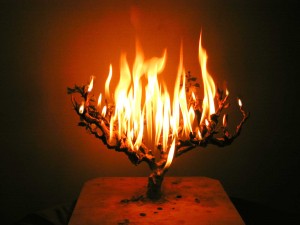
Burning bush

Exodus 3:1-6

Click for source

Usually when we talk of a “burning bush experience” we mean a divine encounter of grand proportions.  A happening so earth-shattering it awakens you to spiritual realities.

Yet, when you think about it, a burning bush isn’t the most arresting vision conceivable.  In fact for the director of Exodus the Movie, the special effects required for “the burning bush scene” would be the very least of their worries.  That’s easy compared to magic staffs, miraculous plagues, thundering mountains and Red Sea crossings.

So why the blazing shrubbery?  Is this really the best launch event for the Exodus?  Surely the LORD’s PR company could do better than this, especially considering the budget available!

But no.  Once we understand the symbolism, a burning bush is the most appropriate context for the LORD’s appearance.

Here is how the event unfolds.  Our stranger in a strange land – Moses – was doing what he’d done for the last 40 years: shepherding dumb animals through the wilderness.  He came with his flock to mount Horeb (a.k.a Sinai)…

And the angel of the LORD appeared unto him in a flame of fire out of the midst of a bush: and he looked, and, behold, the bush burned with fire, and the bush was not consumed. And Moses said, I will now turn aside, and see this great sight, why the bush is not burnt.  (Exodus 3:2)

There are three elements here: the bush, the burning and the One in the midst of the bush.

First, the bush.

Many times in the Bible, people are described as like a plant: a vine or a branch or a tree. Usually it’s the people of God en masse who are described like that, or their king is described like that since he sums them up as their representative.  And so you get Jesus saying to His people “I am the vine, you are the branches.”  (John 15:5)  The people of God are a plant grafted into the True Life-Source, Jesus.  So the bush represents the people of God.

Second, the burning.

Many times the suffering of the Israelites in Egypt is described like a furnace (Deuteronomy 4:20; 1 Kings 8:51; Jeremiah 11:4).  It’s a furnace of affliction.

Well here is a bush that is burning.  Burning, but not consumed.  And, wonder of wonders, the Angel of the LORD comes down into the burning bush.

That’s the third element: The One dwelling in the midst of the bush.

But who is He? Well you might know the story of another blazing furnace…

In the book of Daniel we read about a foreign king who throws three faithful Israelites into a “burning fiery furnace.” But when the king looks into the furnace he says this:

Lo I see four men loose, walking in the midst of the fire, and they have no hurt; and the form of the fourth is like the Son of God.  (Daniel 3:25)

This fourth figure looks for all the world like the Son of God.

And when the king releases the three men he says,

“Praise be to the God of Shadrach, Meshach and Abednego, who has sent his angel and rescued his servants!”  (Daniel 3:28)

The fourth figure was God’s Angel.  He’s the very same one who meets Moses in the burning bush – the Angel of the LORD.  Literally that means “The Sent One from the LORD.”  He is the Son of God.  And it is always His nature to come down into the fires to be with His people.

This is why the burning bush is such an appropriate apparition.  How should the good LORD meet with a suffering world?  Incredibly He joins us in the furnace.

In Exodus, the Divine Angel comes down to be with His people to lead them out.  But in the definitive deliverance, He would descend not just to a burning bush but would enter into our humanity for all time.  He would enter our predicament, take our sorrows and sufferings on Himself and then, on the cross, would take our sins on Himself.  There He endured the flames that were destined for us.

And so the Christian can look to Christ crucified and from the midst of His fiery affliction we can hear Him say what He said to Moses:

I have surely seen your affliction, and have heard your cry … I know your sorrows; And I have come down to deliver you.  (cf. Exodus 3:7-8)

What do you think of when you imagine a divine encounter?  A special effects set-piece?  No.  The “great sight” which should astonish the world is this: God sends His Son down into a burning bush, down into the afflictions of His people, down to a bloody cross.  We should all “turn aside” and be amazed, not simply at a God above us or over us.  But a God who shows up in the furnace, to be God with us and for us.

In all their affliction God was afflicted, and the Angel of his Presence saved them: in his love and in his pity he redeemed them; and he bare them, and carried them all the days of old.  (Isaiah 63:9)

A stranger in a strange land

Exodus 2:11-25

Click for source

Exhausted, the freedom fighter slumped by a well.  He had taken a risk, initiating a violent coup.  But now he’s a failed revolutionary without a friend in the world.  A week earlier he had been a prince in the most powerful court on earth.  Now, aged 40, he’s Egypt’s most wanted man.

Moses’ story to date has been an extraordinary tale of rags to riches.  He was born a Hebrew – a member of Joseph’s race.  But Joseph was now long dead and in the next 400 years there was a chillingly familiar progression.  The Jews were first oppressed, then enslaved and finally the labour camps turned to genocide.  Pharaoh had ordered all Israelite boys to be drowned at birth (Exodus 1:11, 22).

But this child was saved.  Instead of being hurled into a watery grave, he was cast off by his mother in a miniature ark (Exodus 2:3) and “saved” out of water.  And that’s what Moses means: “saved” (Exodus 2:10).

In an ironic twist, the child was saved by Pharaoh’s own daughter who then employed Moses’ birth-mother to raise him.  His mother’s experience must have been a real death and resurrection.  She had cast him off on the waters, received him back and was then paid to raise him! (Exodus 2:9)

By his natural mother he would have learnt the stories of Israel.  Stories about Abraham and the promises to his seed.  Stories of how Israel was destined to suffer in Egypt for 400 years.  And that afterwards they’d be saved through a mighty work of God (Genesis 15:13-14).

By his adoptive family he was growing in the wealth and power of Egypt, learning their ancient wisdom and ways. (Acts 7:22)

By the age of 40 he was at the height of his physical and political powers.

And the reader is thinking – “I know how the story goes.  Surely Moses will climb through the ranks of the Egyptian court and, through political cunning or military might, he will liberate his people as an inside job.”

Well, maybe that’s what Moses was thinking.  But that plan goes horribly wrong.

In Exodus 2:11 he makes a ham-fisted attempt at liberation.  One day he comes to the rescue of a fellow Israelite against his Egyptian slave master.  Moses kills the Egyptian.  In Acts chapter 7 we learn that this was meant to be the first act in an uprising of the slaves.  But the Israelites aren’t on board with Moses at all (Exodus 2:14).  The coup is well and truly botched, Pharaoh is alerted and Moses flees into the desert – on the run from the authorities, on the run from his own people.

And so he collapses by the well in wilderness country.  As Acts 7 tells us, he lives out the next 40 years as an insignificant shepherd.

Can you imagine the regrets, day after day?  If Moses was anything like me he’d be complaining, “How can this be used by God?  Shepherding stupid creatures around the wilderness for 40 years?  What possible good could this serve?”

Clearly Moses is feeling sidelined by life.  When he has a son he calls him “Gershom” meaning “stranger”.  He gives the reason in v22,

I have been a stranger in a strange land.

This is the context of God’s mighty deliverance.  Exodus will be the story of God’s salvation.  He doesn’t use a political insider or a popular freedom fighter.  He uses a despised, octogenarian shepherd.

The leader through whom God will bring salvation is brought low – just as low as his battered people.  But the depths are exactly where God loves to work.

As D.L. Moody, once commented:

“Moses spent 40 years thinking he was a somebody, 40 years realizing he was a nobody, then 40 years seeing what God can do with somebody who knows they’re a nobody.”

Fat of the land

Genesis 45:1-28

Click for source

In English we say “the cream of the crop”.  In Hebrew they would say “the fat of the land” (Genesis 44:18).  Not that the ground is particularly oily (they’d also talk about “the fat of the wheat”; Psalm 81:16).  The fat is the best portion.

And this is what Pharaoh offers to Joseph’s brothers:

“Pharaoh said unto Joseph, Say unto thy brethren, This do ye; lade your beasts, and go, get you unto the land of Canaan; And take your father and your households, and come unto me: and I will give you the good of the land of Egypt, and ye shall eat the fat of the land.” (Genesis 45:17-18)

This is a conversation between the arch-ruler, Pharaoh, and his right-hand-man Joseph.  Earlier, Pharaoh had said to Joseph:

“I have set thee over all the land of Egypt.” (Genesis 41:41)

Joseph rules the whole land under Pharaoh. And through Joseph’s wisdom, the land is first made prosperous (Genesis 41) and then redeemed – bought back – into the possession of Pharaoh. (Genesis 47).

Now the famished and guilty brothers of Joseph are given a life-line.  Much more than a life-line.  They come in on his inheritance.

What right do these foreigners have to the fat of the land?  None.  Except that their brother has made the whole land fat.

What right do these brothers have to share in Joseph’s wealth?  None.  By rights Joseph should have sold them into slavery the way they’d sold him.  Yet he receives his brothers to himself.  And they enter into the inheritance of Egypt’s lord. (Genesis 45:8)

Thousands of years later Jesus stood on a mountain proclaiming:

Blessed are the meek: for they shall inherit the earth. (Matthew 5:5)

He doesn’t say ‘they shall inherit eternal life’, though that would be true.  He says they will inherit the earth.  This future hope is not celestial but very much grounded. In fact it is cosmic.  The whole earth.

Who could possibly possess the earth?  Surely only the bold.  Only the go-getters.  Only those who take life by the scruff of the neck.  But no Jesus says it’s the meek.

How is this so?

Well we are like Joseph’s brothers.  We are desperately guilty, desperately needy and should, by rights, be shut out of the inheritance.  But King Jesus is Lord of this world.  It’s all coming to Him.  And all those who come to Him meekly, He receives as family into the fat of the land.

Coat of many colours

Click for source

Genesis 37:1-36

It has all the ingredients for a West End hit.  Jealousy, family intrigue, struggle through adversity, then vindication and reconciliation.  It’s a story that speaks to all.  Because it’s a story based on the original story – the true myth.  Joseph’s story is Jesus’ story told in advance.

Joseph was one of the twelve sons of Israel.  Israel (a.k.a. Jacob) was the son of Isaac, the son of Abraham.

But Joseph was set apart from his brothers.  Jacob gave him a coat of many colours (Genesis 37:3) which, in the Bible, has both priestly and royal connotations.  (Exodus 28:49-40; 2 Sam 13:18)  Joseph was clearly exalted before his brothers, but exalted on behalf of his brothers – that is the role for priests and kings.  Lifted up yes.  But lifted up for the others.

In addition to being priestly and kingly, Joseph also speaks prophetically about his royal priestliness. He tells them his dreams: all around will bow down to him, the favoured son (Genesis 37:5-7).  When the brothers hear of this,

his brethren said to him, Shalt thou indeed reign over us? or shalt thou indeed have dominion over us? And they hated him yet the more for his dreams, and for his words.  (Genesis 37:8).

As with David (e.g. 1 Samuel 17:28), Joseph is another Christ-figure whose actions for his brothers provoke their jealousy.  We’re the same. We don’t want our Brother to step in and do it for us.  We’d rather do it ourselves.  And so when our Brother lifts himself up – even if it’s entirely for our benefit – we want to cut him down.

This is what his brothers do.  They toy with killing him but Reuben, the firstborn, objects: “Let’s not and say we did.”  So they sell him into slavery instead and give back to Jacob the coat – now stained with blood – supposedly Joseph’s.  The favoured son is now dead to his father and descends to Egypt, the land of darkness and bondage.

To add to his woes, Joseph’s righteousness, far from being rewarded, plunges him further into the pit.  He ends up in an Egyptian prison (Genesis 39).  Yet the Bible insists that he is not suffering for his own sins.  The LORD is with Joseph and causes him to prosper (Genesis 39:21-23).  In fact, through the power of the Spirit (Genesis 41:38) and on the third anniversary of a third-day resurrection experience (Genesis 40:20; 41:1), Joseph is vindicated.  He is lifted from the pit to the throne to be Pharaoh’s right-hand man (Genesis 41:39-45).  He was thirty years old! (Genesis 41:46; cf Luke 3:23)

Tomorrow we will see how Joseph’s wisdom as ruler brings prosperity to the land.  But for now let’s note how the wise and righteous rule of Joseph brings blessing even for his brothers.  Genesis 42-50 details how the plunging down and lifting up of the one brother – Joseph – benefits the whole family.  The brothers, wasting away through famine, must come to Egypt to find food.  In perhaps the most dramatic scene of all, Joseph finally reveals himself to his needy brothers:

I am Joseph; doth my father yet live? And his brethren could not answer him; for they were troubled at his presence.  And Joseph said unto his brethren, Come near to me, I pray you. And they came near. And he said, I am Joseph your brother, whom ye sold into Egypt. Now therefore be not grieved, nor angry with yourselves, that ye sold me hither: for God did send me before you to preserve life.  For these two years hath the famine been in the land: and yet there are five years, in the which there shall neither be earing nor harvest.  And God sent me before you to preserve you a posterity in the earth, and to save your lives by a great deliverance.   So now it was not you that sent me hither, but God: and he hath made me a father to Pharaoh, and lord of all his house, and a ruler throughout all the land of Egypt.  (Genesis 45:3-7)

Could it really be that the near-murder of their brother had been turned by God into their own salvation?  Surely their treatment of righteous Joseph should have proved their condemnation!  How could it be that their wicked damning of Joseph becomes the very means by which they are saved?

In the hands of this God – the God who redeems Joseph from the pit – even great evil is turned to good.  As Joseph would later say to them:

ye thought evil against me; but God meant it unto good  (Genesis 50:20)

And so Joseph turns out to be worthy of the royal priestly coat.  Just like Jesus, he is the king-priest lifted up for his brothers.  And even when he is wickedly cut down it proves the salvation of those who harmed him. Jesus says these words to us today:

“Come near to me.  You did sell me out.  But be not angry nor grieved with yourselves.  God sent me before you to save you by a great deliverance.”

How can we not therefore humble ourselves before him – knowing our own guilt?  How can we not bow down to our Brother who went to the depths for us?

Test of faith

Genesis 22:1-19

Click for source

What is the Bible?

Sometimes Christians are the worst at answering that question.  Many will reply: “The Maker’s Instruction Manual.”  Or “God’s Road Map.”  Most often religious folk will see it as, essentially, a moral guidebook for right living.  But if ever there was a story to explode that misconception it’s this one.  Abraham has his faith tested:

And it came to pass after these things, that God did tempt Abraham, and said unto him, Abraham: and he said, Behold, here I am. And he said, Take now thy son, thine only son Isaac, whom thou lovest, and get thee into the land of Moriah; and offer him there for a burnt offering upon one of the mountains which I will tell thee of.  (Genesis 22:1-2)

How on earth are we meant to understand this story?  Written in a holy book no less?  What’s the moral supposed to be, Go thou and do likewise?

No.  Genesis 22 is meant to be read the way the whole Bible is meant to be read – first and foremost as a witness to Jesus Christ.  And when we read it this way, the whole thing becomes clear.

You see Isaac is a promised seed of Abraham and described as the only beloved son.  Most literally this is not true – Abraham has another son – Ishmael.  But in the terms of this story Isaac is a prototype of Christ – the seed of Abraham.  And he is to be slain as a sacrifice of atonement on a mountain in the region of Moriah.  Mount Moriah is the temple mount of Jerusalem (2 Chronicles 3:1).

So here is the only beloved son to be offered by the father on a hill outside Jerusalem to make atonement.  Genesis 22:6 tells us of the father carrying the tools of judgement – the fire and knife.  The son carries the wood as they trudge up the hill.  Isaac asks his father about the sacrifice.  Abraham replies prophetically: “God will provide himself a lamb for a burnt offering” (v8).

On this day the Angel of the LORD intercepts the judgement (v11ff). The name of this divine figure means “the Sent One of the LORD”.  He is the pre-incarnate Jesus Himself.  And here He prevents the sacrifice He would embrace two millennia later.

On this day, a ram is provided as a substitute for Isaac (v13).  But of course, Abraham had prophesied that a lamb would be provided (v8).  That’s what he and all the generations were waiting for in the centuries following – the Lamb of God, the Beloved Son, the Seed of Abraham.  God’s provision of atonement was yet future.  And so,

Abraham called the name of that place Jehovahjireh [meaning “The LORD will provide”]: as it is said to this day, In the mount of the LORD it shall be seen [or ‘provided’].  (Genesis 22:14)

For future generations God’s people would look forward to the Lamb, even knowing the mountain on which He’d be provided.

When the Bible is read primarily as a rule-book it disintegrates between our fingers.  With such a mindset, Genesis 22 is a scandal and a barrier to faith.  Yet when the Bible is read as intended we see it as a testimony to Christ.  At that point Genesis 22 becomes not a barrier but a boost to faith.  Suddenly we realise that all the Scriptures and all the saints in every age are fixed on the one truth that towers above all others:

Behold the Lamb of God, which taketh away the sin of the world. (John 1:29)

Fire and brimstone

Genesis 18:16-33; 19:23-29

Click for source

These days the phrase “fire and brimstone” is more associated with a style of preaching than with the reality they preach.  “Fire and brimstone” preaching is what our culture fears.  Rarely does it occur to us to fear fire and brimstone itself.

“Fire and brimstone” continually describes the judgement of God in the Bible (see especially Revelation chapters 14, 19, 20 and 21).  In Revelation this judgement is intended for the devil and his angels.  But, crucially, it befalls any who follow them (Matthew 25:41).

Both fire (e.g. Acts 2:3) and brimstone (Isaiah 30:33) are associated with the Spirit or Breath of God.  That’s an intriguing link given what we will discover today.

Certainly fire can be a description either of the love or wrath of God.  It represents either the sunshine of His blessings or the blazing fury of His anger.  So in a deep sense the judgement of God is the special presence of God to His enemies.  God’s visitation is salvation to His friends and destruction to His foes.

For Sodom and Gomorrah it was a salutary judgement to which the prophets, apostles and Jesus Himself refer continually.

So let’s think about a topic from which we usually shrink.  Let’s examine this first mention of “fire and brimstone” because as we study the context of the LORD’s judgement we will learn much about His justice and mercy.

First, let’s think about the justness of judgement.

The episode begins in Genesis 18 with the LORD’s visit to Abraham.  He appears to Abraham along with two angels (Genesis 18:1,2; 19:1).  Thus we have here the Son of God, the pre-incarnate Christ, with two attendants.  In verse 20 the LORD Christ explains why He has come:

Because the cry of Sodom and Gomorrah is great, and because their sin is very grievous; I will go down now, and see whether they have done altogether according to the cry of it, which is come unto me; and if not, I will know.  (Genesis 18:20-21)

There are offences that stink to high heaven.  And that is a wonderful thing.  In a world where concentration camp commandants can escape to South America and bounce their grandchildren on their knees, we long for justice.  This episode reminds us that there is justice.  Wickedness creates an outcry – an outcry that is heard and that moves a loving God.

Second, let’s think about the divine reconnaissance.

This incident shows an extraordinary concern for first-hand knowledge.  The LORD is anything but blasé about “fire and brimstone”.  He condescends to an elaborate fact-finding mission.  This same concern leads Him to take flesh in the fullness of time.  Not just to view wickedness from the outside but to “know” it as its supreme Victim.

Third, let’s think about Abraham’s intercession.  From chapter 18 and verse 23 we read that Abraham “drew near”.  That’s a lovely detail.  The condescending LORD stoops down and His trusting friend draws near – and draws near to haggle.

Essentially Abraham asks “Will you judge these cities if there are 50 righteous folk in them?”  Indeed the LORD would not.  “What about 45?  40?  30?  20? 10?  You wouldn’t sweep away the whole place if there were 10 righteous people would you?”  The LORD promises not to.

The heart of Abraham’s plea is verse 24:

Shall not the Judge of all the earth do right?

This whole episode is quite breath-taking.  It is astonishing that the LORD should enter into such haggling, should promise to remember mercy and, most of all, should submit to a standard of “right”.  Isn’t He the LORD?  Doesn’t He simply determine what is right?

The LORD’s stooping is not simply for information but it extends even to accountability – accountability to creatures who are “but dust and ashes.” (Genesis 18:27)

And again this stooping is extended in the Gospels when the LORD becomes not only an accountable Judge, but an accused Defendant!

Finally, let’s think about mediated judgement.  Once Abraham has finished haggling, the LORD moves on to Sodom and in Genesis 19:24 He finally metes out judgement:

Then the LORD rained upon Sodom and upon Gomorrah brimstone and fire from the LORD out of heaven.

Notice the two persons called “LORD” in this verse.  There is the LORD on the earth who’s been speaking with Abraham, and there is “the LORD out of heaven.”  The Son rains down judgement from the Father.  As Jesus says in John 5:22, “The Father hath committed all judgment unto the Son.”  It is Jesus who judges the world.  It is Jesus who is in charge of the fire and the brimstone.

This, ultimately, is what gives us confidence that the Judge of all the earth will do right.  We know that the One who judges is the One who’s been the judged.  We know that He has climbed down from the throne and put Himself in the dock to receive the harshest sentence imaginable.  On the cross He has proved Himself more willing to suffer the fire and brimstone than to dish it out.

These considerations won’t answer all our questions about judgement. But they point us in the direction of an answer.  Whatever questions we have about judgement we can bring them to the cross and say “I trust this LORD to do what is right.”

Sodom and Gomorrah

Genesis 19:1-14

Click for source

The mention of “Sodom and Gomorrah” conjures up images of unbridled lust and debauchery.  They were the original sin cities.  And their judgement is constantly held up in the Bible as a cautionary tale for all.  But both their sins and their judgement aren’t as straightforward as some might present it.

Almost the first description of Sodom says this:

the men of Sodom were wicked and sinners before the LORD exceedingly. (Genesis 13:13)

What exactly were their sins?  They are enumerated in multiple ways by different biblical authors.  Peter calls the people “lawless”.  (2 Peter 2:6)  Jude speaks of them:

giving themselves over to fornication, and going after strange flesh (Jude 1:7)

The climax of their lusts are recorded in Genesis 19 where angels, sent to assess the guilt of Sodom, are besieged by would-be rapists.  They had tried every kind of flesh under the sun yet their appetite for “strange flesh” is insatiable. These angels represented Sodom’s last hope for a reprieve.  Yet instead of pleading with them, they sought to “know” them (Genesis 19:5).

Perhaps these are the kinds of sins we expect of “Sodomites”.  Yet listen to Ezekiel’s description of Sodom’s “iniquity”:

Behold, this was the iniquity of thy sister Sodom, pride, fulness of bread, and abundance of idleness was in her and in her daughters, neither did she strengthen the hand of the poor and needy.  And they were haughty, and committed abomination before me: therefore I took them away as I saw good.  (Ezekiel 16:49-50)

Notice how sexual sins (probably the “abominations” referred to) are seen in the context of broader social relationships.

Ezekiel – like the rest of the Bible – is interested in greed every bit as much as lust.  Self-exaltation, self-satisfaction, self-preoccupation – these are the iniquities emphasized in Ezekiel’s assessment.

The Bible is not obsessed with sex.  But it does recognize the inter-relatedness of sex to all of life.  “One flesh” has its context in the committed relationship of man and woman in covenant union.  Bringing it out of this context is both a sign and a source of other relational disordering.  When covenant relationships are disordered, community relationships also fall apart.  The bedroom might be private but it’s not isolated.  And it’s all a part of the “cry” that comes up unto the LORD (Genesis 18:20).

But if it’s unbalanced to view Sodom and Gomorrah’s sins as simply sexual, it’s also unbalanced to see their fate as simply a warning to sexual sinners.

The fate of Sodom and Gomorrah is held up as a warning many times in the Bible (more on this tomorrow).  Yet the caution is never addressed to sexual sinners per se.  Almost exclusively ‘a fate worse than Sodom’ is said to await the people of God. It’s when the people of God turn out to be faithless that they are likened to Sodomites.

Jesus told His disciples that those rejecting the gospel message were like Sodom and Gomorrah (Matt 10:14-15).  And Moses says the same thing in Deuteronomy 29.  He tells the Israelites that their unfaithfulness will lead to a judgement “like the overthrow of Sodom and Gomorrah” (v23).  When the promised land is laid waste like Sodom, people will ask, “Wherefore hath the LORD done thus unto this land?” (v24)

Then men shall say, Because they have forsaken the covenant of the LORD God.  (Deuteronomy 29:25)

The ultimate issue is covenant faithfulness.  And the ultimate covenant is the one the LORD makes with us.

To be unfaithful to human covenants will mean permutations of sexual Sodomy.  Yet there is a deeper unfaithfulness – a root unfaithfulness that is the source of all sin and the cause of all judgement.  To be unfaithful to God’s covenant love is a spiritual Sodomy.  And in the Bible, that is even worse.

Circumcision

Genesis 17:1-27

Click for source

“Miss!” asks the inquisitive Sunday School-er, “What’s circumcision?”  Miss turns the colour of an Englishman on Bondi Beach.  “Don’t worry about that,” she flusters.  “That’s for grown-ups.”

But it’s not.  According to Genesis 17, circumcision is for 8-day-olds.  It was a “sign of the covenant” given to Abraham and his seed.  So from the earliest time, Israelite boys were to have the LORD’s covenant “in their flesh.” (Genesis 17:13)

There are two repeated words in the chapter that tell us the meaning of the ritual.  The first is the word “cut”.

When the Hebrews spoke of making a covenant, they wouldn’t say “make”, they’d say “cut”.  You “cut” a covenant.  Yesterday we saw why.  The LORD pronounces His covenant vows while passing between the cut animals.  His promises were blood-oaths grounded in His own future cutting off.

So naturally the “sign of the covenant” would be a “cutting” sign.  In fact the word for circumcision is the word “cutting off.”  And for those who wouldn’t own the sign of circumcision – they would be “cut off” from the community (Genesis 17:14).

Why?  Well that brings us to the other prominent word in this chapter: “seed”.

In fact it occurs 7 times in Genesis 17.  Abraham is reminded again and again that the promises of God are for his seed.

Well then, if the promises are to Abraham’s seed, doesn’t it seem a little dangerous to be cutting off the flesh… down there?  Aren’t the Israelites doing something perilously close to cutting off the seed??

Indeed they are.  But that’s the point.  The sign of the covenant will be a bloody pre-enactment of the cutting off of The Seed – Jesus Christ.  Abrahamites will wear in their bodies a symbol of the cross – the true cutting off.  For when the LORD Christ is cut off we are spared the same.

Therefore circumcision is, as Paul says, a sign of righteousness by faith (Romans 4:11).  Those who cut the sign of the covenant into their flesh were expressing faith in the true cutting-off.  And by that cutting off on the cross we are all justified.

Circumcision was never meant to be a badge of pride.  It’s not something you could show off!  It was never meant to be a human work to please God.  Actually it was a sign of God’s covenant love given to His people.  It was a sign and seal for God’s people and their households – a gracious gift to unworthy people.  Even to unresponsive people (8 day olds!).

Today, we do not put a bloody sign of the covenant onto our bodies.  That would be inappropriate now that the Seed has been cut off.  Instead we have a water-sign – baptism (Colossians 2:11-12).  Yet both signs are gracious gifts from God – seals of His covenant love.  And the people of God are meant to grow up under these signs and, as they grow, to own the realities to which they point.  Consider these words from the French Reformed baptism service.  They capture beautifully what it means to grow up under the sign of the covenant.  May these promises surround you today:

“Little child, for you Jesus Christ came into the world, laboured and suffered.  For you, he went through the agony of Gethsemane and the darkness of Calvary.  For you, he cried: « It is finished! ».  For you, he died and for you he triumphed over death.  Yes, for you, little child, the declaration holds true, We love God, because he first loved us. Amen!”

Covenant

Genesis 15:8-21

Click for source

Yesterday we considered the first half of Genesis 15.   We thought about the LORD overwhelming the fears of Abraham with even greater promises.  Today we’ll think about the climax of that process.

Abraham has trusted the LORD Christ and been pronounced “righteous” in God’s sight (v6).  It’s wonderful news but Abraham asks “How can I know?” (v8)

How can any sinner be sure that they are counted righteous in God’s eyes?

The LORD’s answer is to make a covenant with Abraham.

What is a covenant?

A covenant is a binding promise that’s motivated by unconditional love.  Marriage is a covenant relationship – you say ‘I will love you.’  You don’t say, ‘If you do X, Y, and Z, I will be obliged to love you between the hours of 5 and 7 on a Thursday evening.’  That would be a contract.  Contracts are tit-for-tat.  Covenants are based on unconditional love.

A covenant says ‘I will – for better for worse, for richer for poorer, in sickness and in health – I will.’

Wonderfully, the LORD enters into a covenant with us.  The most basic form of His covenant is this: “I will be your God, and you will be my people.”  This is what it means to be “righteous” before God.  It’s not simply about having a ‘not guilty status’ before the Judge.  It’s about being united to a Righteous Husband who shares His status with us.

But here in Genesis 15 there are some elaborate and disturbing rituals surrounding the marriage ceremony.  You see the aisle down which you pass to make this covenant is strewn not with flowers but with dead animals!

From verse 9 Abraham must find sacrificial animals and cut them in half.  He must place them on either sides of a corridor.  Then, in the midst of their broken bodies the LORD (signified, v17, by a smoking furnace and a burning lamp) passes through and He pronounces a covenant promise.

Essentially the LORD is saying “So let it be done to me if I fail to deliver on my promise.”

There’s an example of this in Jeremiah 34:18.  Those who pass through the pieces are saying, “You can treat me like these butchered animals if I don’t keep my side of the bargain.”

We have a silly version of this in the school-yard rhyme: ‘Cross my heart and hope to die, stick a needle in my eye.’  We’re saying, if I’m lying you can cut me up.  Now we don’t mean it when we say stuff like that.  But in the Bible, they meant it.  “Tear me apart if I don’t come through for you!”  That’s a serious promise, that’s a covenant promise.

But notice what’s happening in Genesis 15.  The LORD doesn’t make Abraham walk through the pieces!

In verse 12, Abraham is completely out of it.  “An horror of great darkness fell upon him.”  He’s been well and truly swept off his feet and contributes nothing to the proceedings.  Only the LORD passes through the pieces.

And here’s the point:  We don’t make the covenant with the LORD, He makes the covenant with us.  Abraham is not pledging to keep up his end.  The LORD is pledging to keep up both ends of the covenant.

The LORD says to us “If I don’t keep up my end of the bargain you can kill me.  And if you don’t keep up your end you can kill me.  I’ll take responsibility for any failure of mine and I’ll take responsibility for any failure of yours!

This is unconditional, unearned, unprecedented, blood-earnest, covenant love.

The LORD says, “If I fail, I’ll die.  And if you fail, I’ll die.  But come what may, through bloody sacrifice, through suffering, pain and tears: I will be your God and you will be my people.”

And of course we didn’t hold up our end.  We were never going to hold up our end.  And it did cost Him everything.

Because there was another day of horror and great darkness.  There was one Friday when the LORD Himself was torn apart and His blood shed.  The blood of the covenant poured from His veins.

We don’t offer a drop.  He doesn’t spare a drop.

We’re the ones who break the covenant.  His is the body that’s broken.

We are the ones deserving blood-shed.  His is the blood that is spilt.

How can I know?  How can I know that a sinner like me is righteous in God’s sight?  How can I know that I really enjoy the covenant love of God?

Look to the place where the covenant was cut.  Look to the cross and realise this: He upholds both ends of the covenant.  He underwrites it in His own blood.  He’d rather die for you than live without you.