

Purchase these quarterly devotionals in time for 2013.
And coming very soon – an all-year version. 365 readings in one volume – a great Christmas gift.
Stay tuned for more details.
Purchase these quarterly devotionals in time for 2013.
And coming very soon – an all-year version. 365 readings in one volume – a great Christmas gift.
Stay tuned for more details.

"Look at that! Brilliant! You kill the leader and you nip the whole movement in the bud." (Click for source)
Acts 17:1-15
On Good Friday, Christianity was “down and out.” The Christ was dead and buried. His followers were despondent and scattered. And that should have been that.
Yet, within a very short period of time, Christ’s people were said to be ‘turning the world upside down.’ How did such an extraordinary revolution happen? Not through the sword, not through political machinations, not even through grass-roots activism. The world was turned upside-down in the first century (and continues to be turned upside-down today) through the preaching of a message.
Just look at the context for this phrase… In Acts 17 Paul and his associates go to the Greek city of Thessalonica.
“And Paul, as his manner was, went in unto them [at the synagogue], and three sabbath days reasoned with them out of the scriptures, Opening and alleging, that Christ must needs have suffered, and risen again from the dead; and that this Jesus, whom I preach unto you, is Christ.” (Acts 17:2-3)
Here’s what was so volatile – the preaching of a ‘reasoned’, ‘scriptural’ message. The message concerns a King – the Christ. But this King is unlike all our expectations for kings. He suffers and dies before rising again. Yet it’s this upside-down message that unleashes an upside-down revolution.
You see some Thessalonians believed Paul’s message. The Jews that didn’t, ‘moved with envy’, stirred up trouble for the apostles. And this was their report to the powers that be:
“These that have turned the world upside down are come hither also.” (Acts 17:7)
Perhaps we think it’s counter-intuitive that a message “turns the world upside down.” But let’s consider the impact of this message over the last 20 centuries in the areas of politics, science and economics. The gospel of the suffering and rising Christ has made all the difference…
When people believe that the Lord of all became a servant (or, as Mark 10:45 calls Him, “a minister”) then our understanding of earthly power is transformed. The most powerful needs to be the prime minister – the chief servant.
When people believe that the Ruler of heaven reigns as Man and even because He is now Man, then we start to believe that government should be “of the people, for the people and by the people.”
When people believe that the Logic of all creation took flesh (John 1:14) and was seen, handled, tested and known (1 John 1:1-4), then we start to study the world in a new way. The Word who became flesh leads us to expect both Laws and empirical testing to discover those laws. If we only believe in “laws” we will create philosophers. If we only believe in “empirical testing” we will create technology. But for the modern scientific method you need both. Without the Biblical worldview it is inconceivable that science as we know it could have arisen.
When people believe that God’s riches – His grace – should not be paid back to God (as though He needs anything) but freely paid forwards to our fellow man, then we begin having a different view of earthly riches. Freed by God’s grace we stop hoarding or displaying our wealth and start paying it forwards, re-investing it. And we begin to realise the truth of Christ’s words “freely you have received, freely give.”
These are just some of the macro-effects of the gospel message on our culture. None of them are, strictly, part of the message. They are simply outworkings of the gospel in a culture where this message is taken seriously. In addition to these fringe benefits, people are brought to an intimate knowledge of the living God, set free from the powers that enslave them, cleansed from guilt and shame, and given the status, power and indeed life of Christ. What’s more, in Christ they are bonded together into a community of grace – witnesses in the world to God’s reconciling love. They are salt and light and the world cannot help but be changed.
What changes the world? Not our doings, but the proclamation of His doing. That’s the power to turn the world upside down.

Acts 9:1-31
It’s shorthand for any dramatic conversion. People have often said to me that they’re Christians but they’re still waiting for their “Damascus Road Experience.”
But they will have to wait for Christ’s return for anything like what Paul experienced. You see the Damascus Road was not just the conversion of a man, it was the creation of an Apostle. And Apostles needed to have met the risen Christ – both the 11 and Paul himself acknowledge that (Acts 1:21-22; 1 Corinthians 15:1-11). Therefore something extraordinary was needed to turn Saul of Tarsus into Paul the Apostle. The risen Christ had to personally appear. But He didn’t have to appear to a man like Saul! This conversion would model the sheer grace of the Lord.
For a start, Saul was a Pharisee. He describes his past like this:
“Circumcised the eighth day, of the stock of Israel, of the tribe of Benjamin, an Hebrew of the Hebrews; as touching the law, a Pharisee;” (Philippians 3:5)
When Jesus chose the original twelve he chose a tax-collector, Matthew. He also chose a Zealot, Simon. These two were hated and feared members of the establishment and anti-establishment respectively. Nonetheless, there was place in Christ’s kingdom for all manner of publicans and sinners. Yet all the while the Pharisees remained firmly on the outside, muttering (Luke 15:1-2).
Now Christ steps in with compelling force and claims a Pharisee for His own. And not just any Pharisee – the chief persecutor of the early church. Saul oversaw the killing of Stephen in Acts 7 and was known to believers everywhere as “he that destroyed” Christians. (Acts 9:21)
So how was Saul prepared for this religious experience? Was he particularly soft-hearted and receptive to the grace of Jesus that day? No. The grace of Jesus is not attracted to soft-heartedness, the grace of Jesus creates soft-heartedness where before there was stony opposition. Here is the context of Saul’s conversion:
“And Saul, yet breathing out threatenings and slaughter against the disciples of the Lord, went unto the high priest, And desired of him letters to Damascus to the synagogues, that if he found any of this way, whether they were men or women, he might bring them bound unto Jerusalem. And as he journeyed, he came near Damascus: and suddenly there shined round about him a light from heaven: And he fell to the earth, and heard a voice saying unto him, Saul, Saul, why persecutest thou me? And he said, Who art thou, Lord? And the Lord said, I am Jesus whom thou persecutest: it is hard for thee to kick against the pricks.” (Acts 9:1-5)
Saul is not ready for Jesus. Saul is breathing out slaughter against Christ and His people. And notice how personally Jesus takes it. According to Jesus, Saul has been persecuting Himself. The risen Christ is not above and beyond the struggles of this world. He feels His people’s suffering keenly. He is the Head and His body is hurting – therefore Christ Himself is hurting.
Persecuted Christians need to know this. Christ feels this pain and knows how to confront the perpetrators, in His own time and in His own way. But be prepared for Christ to approach the wrong-doers with mercy. This is how He comes to Saul. He even pities his enemy: “It is hard for thee to kick against the pricks.” “Pricks” are the sharp goads at the end of a shepherd’s crook. Sheep going astray harm themselves on the sharpened points and then harm themselves further by kicking against them. That has been Saul’s life. Brought up in the Scriptures, confronted by Christ on every page yet twisting and turning from Him at every opportunity. Conversion for Saul means the end of that kind of suffering. But it will mean a very different kind of suffering from now on.
You see he is blinded by his vision and healed by a Christian called Ananias. Ananias is told by the Lord:
“[Paul] is a chosen vessel unto me, to bear my name before the Gentiles, and kings, and the children of Israel: For I will shew him how great things he must suffer for my name’s sake.” (Acts 9:15-16)
Saul is converted from one kind of suffering – a swimming against the stream of his existence – to another kind of suffering – a swimming against the stream of the world. We can go with the world’s flow and run up against the Lord, or we can walk with the Lord and go against the world’s flow. Paul is summoned to live for Christ’s name’s sake.
And here is the effect. Jesus says to him:
“But rise, and stand upon thy feet: for I have appeared unto thee for this purpose, to make thee a minister and a witness both of these things which thou hast seen, and of those things in the which I will appear unto thee; Delivering thee from the people, and from the Gentiles, unto whom now I send thee, To open their eyes, and to turn them from darkness to light, and from the power of Satan unto God, that they may receive forgiveness of sins, and inheritance among them which are sanctified by faith that is in me.” (Acts 26:15-18)
This is exactly what happens. Paul goes on to live one of the most influential lives the world has ever seen. He writes half of the New Testament and plants churches all around the eastern half of the Mediterranean. Thus the church’s greatest enemy is converted to its greatest asset. That’s what the grace of God does – turns calamity into even greater blessing. And it does so not because of any goodness in us, but despite our deepest evil. You see the witness of Paul to the grace of Jesus is not diminished by his terrible past, but magnified by it. This murderous blasphemer is able to say:
“This is a faithful saying, and worthy of all acceptation, that Christ Jesus came into the world to save sinners; of whom I am chief.” (1 Timothy 1:15)
The conversion of Paul is not meant to make us despair – as though we could never experience such a change. The conversion of Paul gives us hope. The grace of Jesus extends even to His greatest enemies. It most definitely extends to me.

Acts 2:36-47
When we’re “cut to the heart” it’s usually because we’ve been insulted or betrayed or broken up with.
But three times in the book of Acts, the Israelites are “cut” or “pricked” to the heart (Acts 2:37; 5:33; 7:54). Yet with them it’s different. Here’s what pricks their hearts: the preaching of the Apostles. As the sins of the Israelites are uncovered so it feels like a dagger in their chest.
Let’s examine the first instance of hearts pricked by the gospel…
The Duchess of Cambridge was teased terribly at school. While Kate Middleton was at Downe House school she was bullied so badly that her parents took her out after just two terms.
I wonder what those bullies think now?
Maybe the last time they saw her up close they had reduced her to tears. Maybe they laughed and cheered and said good riddance when Kate finally left. Maybe they thought that nothing would ever come of the most unpopular girl in school.
How wrong they were! Through her Prince, she’s now royalty. And one day she will be Queen over those bullies! I’m guessing that her old class-mates have changed their mind about Kate Middleton.
Acts 2 speaks of a similar but vastly more significant change of mind. Peter is addressing the crowd that, 7 weeks earlier, had bayed for Jesus’ blood. Peter, full of the Holy Spirit, pulls no punches:
“Therefore let all the house of Israel know assuredly, that God hath made that same Jesus, whom ye have crucified, both Lord and Christ.” (Acts 2:36)
The charge here is nothing short of deicide – the murder of God Himself! You see, they might have thought little of Jesus in the days of His flesh, but in resurrection God has declared the truth about Jesus: He is Lord and Christ. How would you feel if you were in the crowd?
If you had bullied someone at school, and it turned out they were the son of the headmaster, you would be worried.
What if you’d bullied the Son of God, how much trouble do you think you’d be in?
What if you’d killed the Son of God, what then?
Peter says “You crucified the LORD of Glory.”
How do you respond to such a message? Here’s what the people do. Verse 37:
“Now when they heard this, they were pricked in their heart, and said unto Peter and to the rest of the apostles, Men and brethren, what shall we do?”
Pricked in the heart. Peter’s words are like a sword straight through them. What should they do?
Should they try to run and hide? Where would they hide? God’s quite good at hide and seek. He usually wins that one.
Should they hope that God forgets? He’s not particularly absent minded, God.
Should they try to make it up to God? How could they make it up to God? They haven’t just stolen stationery from the workplace – they’ve killed the Lord of Glory!
What should they do? What could they do? Surely this is it for these bullies, these murderers. What hope could there be? Well Peter gives some incredibly good news:
“Then Peter said unto them, Repent, and be baptized every one of you in the name of Jesus Christ for the remission of sins, and ye shall receive the gift of the Holy Ghost.” (Acts 2:38)
This is unprecedented grace. Peter says that God wants to forgive the killers of His Son. And not just forgive them, He wants to give them a gift.
Have you ever heard of a Judge who says “I know you’re guilty but I forgive you.” Can you imagine a Judge whose son was murdered saying “I know you’re guilty but I forgive you”? Can you imagine a Judge whose son was murdered saying, “I know you’re guilty, but I forgive you and I want to give you a gift.” And imagine he says “Here’s my gift – have my daughter’s hand in marriage!” Unthinkable. But that’s just what God is like. He wants to forgive us and give us a gift – the gift of His Spirit. Another Family Member if you like.
He gives us One Family Member – His Son. We kill Him and He pays us back by giving us His Other Family Member, His Spirit! That’s everything He has to give us. It’s incomparable grace. And in the light of it, Peter implores them to change their mind.
That’s what repent means: change your mind. Jesus is Lord. He is the Christ.
It’s like with Kate Middleton. Those bullies used to call her Flaky Pimpletongue. Now she’s the Duchess of Cambridge. One day they will call her Queen. I imagine those bullies have changed their mind about Kate. But the world needs to do the same with Jesus. We used to think He was an inconvenience. We used to try to silence Him. Perhaps we used to use Jesus’ name as a swear word. At best we used to think of Him as a mere teacher or example. We were wrong. He is Lord and Christ and raised to God’s right hand to rule the world. So repent – change your mind… and be baptised.
You see, Jesus was baptized into our kind of life – He stood in our shoes to do life in our place. Now, says Peter, you should get baptised into Him. Be clothed in Him – in His kind of life.
United to Jesus, the gift of the Holy Spirit is freely offered as well as the remission of all our sins. It’s the most incredible promise. Who’s it for? Surely it’s for good people, religious people, respectable people, the super-keen? No, says Peter. Verse 39 – this promise is for you. The promise is for Christ-killers!
For the promise is unto you, and to your children, and to all that are afar off, even as many as the Lord our God shall call.
You can’t be too bad, you can’t be too immature, you can’t be too far from God – the promise is for you. Because Christ is for you. He’s even for His killers. He is most definitely for you.
In spite of the worst crimes imaginable we are given God’s Son, we are given His Spirit, we are forgiven all our sins and called home to God’s Family Life. All we’ve ever done is cause His death. All He’s ever done is give us more. When we see this gospel reality, our heart are not just pricked, they are melted.

Click for source
Acts 2:1-41
If this phrase is used today it’s usually as a playful archaism.
– “That’s my boy,” says the teasing father, “the fruit of my loins.”
– “Dad!!!”
But actually it’s a great compliment. There’s only one person in the Bible who is specifically referred to as ‘loin-fruit’: Jesus. Well of course – the One who is the original Seed, comes in the fullness of time as Fruit.
Let’s get the context for this phrase.
It’s the day of Pentecost. 50 days since Jesus rose from the dead. 10 days since He ascended into heaven. And on this Sunday, the Holy Spirit comes in power to clothe the church for its witness to the world.
At the time, the whole nation of Israel was gathered to celebrate the ancient festival of Pentecost. It’s seven weeks after that post-Passover festival of “Firstfruits” when the green shoots of the coming harvest were presented to God. Now at Pentecost, the new batch of grain is brought before the LORD (Leviticus 23:15-21). It isn’t just firstfruits, this is now the harvest, and everyone would be thinking of “fruit.”
Now remember the last time these Israelites were all together. It was Passover when they had cried out unanimously: “Crucify Him, Crucify Him!” And in spite of their hatred, the Lord Jesus responded on the cross: “Father, forgive.” Now, as the Christ-killers reconvene, there’s an opportunity for Christ’s prayer to be answered.
The Holy Spirit empowers the disciples to speak to the international gathering – each one hearing them in their native language. It’s a wonderful miracle for Pentecost, breaking down barriers so that all sorts of “new grain” might be harvested. Peter steps forward to explain this sign of new life coming upon the world (Acts 2). First he quotes Joel and explains how the ancient prophet predicted this breakdown of the old barriers. The end times are now upon us, just as the Scriptures foresaw.
From verse 22-32 Peter narrates the events of Christ’s life as the fulfillment of another prophet. According to Peter, David was a prophet and knew “that God had sworn with an oath to him, that of the fruit of his loins, according to the flesh, he would raise up Christ to sit on his throne; He seeing this before spake of the resurrection of Christ.” (Acts 2:30-31)
The Psalms are not ultimately chronicling David’s own experiences of suffering and glory. King David knowingly put words to the experiences of the Messiah – who would be the fruit of his loins. David looked forward to his Seed who would be planted into the ground but raised up by God to be a fruitful Vine for all.
People commonly talk of living on in their progeny. David was someone who really could trust in that! That’s because Christ, his Seed, was the Firstfruits of a bumper crop of resurrection.
Here is the true meaning of Pentecost. At Passover the Seed died. On the third day, He rose again – the Firstfruits of those who have fallen asleep (1 Corinthians 15:20). And on the basis of this Firstfruits, the world can be grafted in to find new life where before there was only death and barrenness. The Fruit of David’s loins was not only fruitful for Himself, He has enough life bursting out of Him for a cosmic harvest.

Click for source
Matthew 28:16-20
Thomas Jefferson once wrote:
“When we shall have done away the incomprehensible jargon of the Trinitarian arithmetic, that three are one, and one is three; when we shall have knocked down the artificial scaffolding, reared to mask from view the simple structure of Jesus; when, in short, we shall have unlearned everything which has been taught since His day, and got back to the pure and simple doctrines He inculcated, we shall then be truly and worthily His disciples.”
Jefferson is not alone. Many Christians consider the Trinity to be a mathematical problem, an artificial scaffolding and an obscurity that masks the simple teaching of Jesus. Yet to think this way is to deny the very Person and teaching of Jesus.
Trinity and the Person of Jesus
It denies the Person of Jesus because He is, most fundamentally, “the Christ, the Son of God.” Both Mark’s Gospel and John’s Gospel are structured around that full name of Jesus – “the Christ, the Son of God.” This means that He is the One anointed (Christed) without measure by the Spirit and the One eternally begotten of the Father. To know Jesus is to be introduced to His Spirit and His Father. In short, to understand Jesus is already to be drawn into a knowledge of the Three Persons. And to know the Spirit and Father in the Son, is to know the Three as Persons united together in love.
This is the doctrine of the Trinity: God is three Persons united in love. There is no mathematical conundrum here. It’s clear how God is Three – there are Three distinct Persons. It’s also clear how God is One – the Three Persons are united in love. That’s how one-ness happens in the Bible. Adam and Eve are one because they are united in love. The Church is meant to be one by being united in love (John 17:21-22). And the Father, Son and Spirit are one through love. In fact they are so one that they cannot be without each other. The Father is Father of the Son – without whom He would cease to be who He is. Likewise, the Son is Son of the Father – without whom He would cease to be who He is, etc, etc.
The Three are so much One that they are ‘in’ one another. This loving, mutual in-dwelling is the unity of the three. And that’s where we get the word “trinity” from. It’s the “tri-unity” – the loving unity of the three. This is who our God is.
Trinity and the Teaching of Jesus
Not only is the Trinity simply the explication of the Person of Jesus. Contrary to Jefferson’s assertion, the Trinity is the teaching of Jesus too.
Just before He ascended to heaven, He commanded His disciples:
“Go ye therefore, and teach all nations, baptizing them in the name of the Father, and of the Son, and of the Holy Ghost.” (Matthew 28:19)
Notice that there are not three names here. There is only one name – but that one name is constituted by these three Persons – the Father, Son and Holy Ghost.
What we have here is, essentially, the Aaronic blessing brought into the New Testament. In Numbers 6, the High Priest was meant to put the name of God onto the people. And that name involved three different divine movements:
“Speak unto Aaron and unto his sons, saying, On this wise ye shall bless the children of Israel, saying unto them, The LORD bless thee, and keep thee: The LORD make his face shine upon thee, and be gracious unto thee: The LORD lift up his countenance upon thee, and give thee peace. And they shall put my name upon the children of Israel; and I will bless them.” (Numbers 6:23-27)
The first movement is blessing and keeping. The second movement is the revelation of God’s radiant Face to shine in grace. The third movement is turning that light personally upon the people to give them peace.
And now Jesus tells His followers – You are all priestly. But now it’s a priesthood to the nations. Bring them in and put God’s name on them. The Father is the Fountain of all blessing. The Son is the shining Face, radiating God’s grace. The Spirit turns the world to that Radiance to give them peace.
When we put these truths together, what do we have?
Well a disciple of ‘the Christ, the Son of God’ is filled with His Spirit and adopted by His Father. Such a person is a little christ, a little son or daughter of God. And the sign of this reality is baptism into the Triune Name where a person is brought into the sphere of the Triune blessing. Here the Spirit ever turns us to the Son, in whose face we see the Source of all blessing, the Glorious Father.
Christ’s “Great Commission” is the mission of the Triune God, extended through His people, reaching the world. As little christs in The Christ – we are sent to the nations, presenting God’s Face to the world: Jesus. In Him, they too can be made a disciple. They too can be baptised into the loving unity of Father, Son and Spirit.
The Trinity is not incomprehensible arithmetic. “The Father, Son and Holy Ghost” is not a problem to be solved. The Trinity is the very name and nature of God. And in the loving unity of Father, Son and Holy Spirit, we find our place – united to Jesus, anointed with the Spirit and calling on our Abba, Father.
Jefferson could not be more wrong. The Trinity is not the scaffolding – it is the very centre of our faith. There is nothing purer, simpler or more worthy in all the doctrines of Christ!

Click for source
John 20:1-31
“If God came down right now, I’d believe. If He showed up in all His Godness and proved Himself to me, I’d bow down and worship. I won’t believe if I can’t see, hear and touch Him – but if He appears, I’ll believe.”
Have you ever said that? Or thought it? Well, that’s Thomas’ question.
“Except I shall see in his hands the print of the nails, and put my finger into the print of the nails, and thrust my hand into his side, I will not believe.” (John 20:25)
Thomas wasn’t there when Jesus had appeared to the other disciples the week before. And he doesn’t believe the eye-witness testimony of the apostles. He wants his own proof. Tangible, in your face, see it, touch it, taste it, feel it, proof.
But he is knocked off his feet when this proof comes. Verse 26:
“And after eight days again his disciples were within, and Thomas with them: then came Jesus, the doors being shut, and stood in the midst, and said, Peace be unto you. Then saith he to Thomas, Reach hither thy finger, and behold my hands; and reach hither thy hand, and thrust it into my side: and be not faithless, but believing.” (John 20:26-27)
Thomas had wanted to see these wounds. He demanded to see these wounds. And so Jesus gives him more than he bargained for. He even invites Thomas to thrust his hand into His side! Incredible.
Jesus seems proud of His scars. He displays them as badges of honour, because these wounds carry a scar story that beats every scar story ever told.
All scar stories have a certain shape: I was travelling along quite nicely until I encountered… a dog / a ball / a car / a fist / the force of gravity. It hurt a lot, but I’m ok now. And I have the scars to prove it.
Jesus’ scar story goes something like this: Things were fine until I encountered… planet earth. They did their worst to me, and it hurt immensely. But I’m ok now. And I have the scars to prove it.
So there is Jesus confronting Thomas with His war wounds – the marks of His suffering love. And in verse 28 Thomas can’t control himself any more: He exclaims to Jesus, “My LORD and my God.”
It’s one of the mountaintop declarations of the Bible. And what has prompted it? The wounds of Jesus. This is not a cowering response to the strength of Christ’s resurrection. This is worship elicited by the sacrificial love of His death. Thomas understands the scar story. He sees that Jesus has come to our aid and stuck up for us in the only fight that really matters. And He’s won. In gratitude and praise, Thomas cries out “My LORD and my God.”
Not simply, “The LORD” but “my LORD”. It’s personal.
Is it personal for you? Or are you still something of a doubting Thomas?
But perhaps you’re thinking, “It’s alright for Thomas. He got to see Jesus. What about me?”
That’s why Jesus answers with verse 29:
“Jesus saith unto him, Thomas, because thou hast seen me, thou hast believed: blessed are they that have not seen, and yet have believed.”
Blessed are people when they are not like Thomas. Blessed are we when we don’t see and yet believe. How is that possible? John’s Gospel continues:
“And many other signs truly did Jesus in the presence of his disciples, which are not written in this book: But these are written, that ye might believe that Jesus is the Christ, the Son of God; and that believing ye might have life through his name.” (John 20:30-31)
We can have a more blessed experience than Thomas. How? We can trust the written, eye-witness testimony. And Jesus says that these Scriptures (of which John’s Gospel is a part) are better than a one-off resurrection experience.
How could that be true? Well just imagine that Jesus appeared to you tonight at the end of your bed. Imagine you saw His wounds and heard Him say ‘Peace’ to you personally. That would give you a spiritual high for days. Weeks, even!
But fairly soon you’d start to wonder whether you’d dreamt the whole thing. People would ridicule you for your claims and pretty soon you’d need another appearance.
If you have ever asked for an extraordinary appearance of God, you are asking for something that will impress you today but will ultimately make you doubt more than believe.
It is more blessed – it is better – to go on the eye-witness testimony of the Bible. Because with the Bible, it’s there in black and white for all time. At three in the morning when I have doubts. When loved ones die. When I’ve lost my job. I can always see Jesus, by opening my Bible and seeing Him in the sacred story.
If I had physically touched the risen Christ twelve years ago – by now my memory would have faded. Instead I met Jesus in the pages of the Bible, and I am seeing Him more clearly today than when I first believed. As I go deeper into the Bible His wounds are more vivid, His scar story is more real, His love seems more profound – all through the pages of Scripture.
All of us are a Doubting Thomas at various times and to various degrees. But the Holy Spirit has given us an antidote:
“These are written, that ye might believe.”
If that’s true – how should we read our Bibles? Answer: Expectantly. We should seek a more blessed encounter than the Upper Room. We should desire a coming of Christ, a sight of His war wounds and a response of worship – “My LORD and my God.”

Click for source
Matthew 28:1-15
Woody Allen is famously fearful of death (of course he maintains he’s not afraid, he just ‘doesn’t want to be there when it happens’). He was once asked, ‘Aren’t you pleased to know you’ll live on in the hearts and minds of those you’ve touched?’ Woody said ‘I don’t want to live on in hearts and minds, I want to live on in my apartment.’ That’s what we all want – resurrection. It’s exactly what Jesus offers. And yet it’s the last thing we expect.
It sounds like madness to even contemplate “living on in my apartment.” Sure, living on in memories is reasonable. And living on in some non-physical, spiritual dimension sounds plausible… at a stretch. But living on in immortal, bodily, earthly life? That’s the stuff of fairytales surely. Everything in our natural experience works against resurrection hope. Our ordinary lives teach us to believe Monty Python’s line: “Life is quite absurd and death’s the final word.” Life leads to death. That’s the trajectory of this world and of Adam its original head. Life and then death.
But Jesus came to reverse the way of Adam. He came to turn the world right-side-up. And therefore it strikes the children of Adam as utterly new and strange. On that first Easter Sunday, the women came to the tomb expecting to pay their last respects to a departed friend. They came to mark an ending. Instead they were witnesses to the one great beginning:
“In the end of the sabbath, as it began to dawn toward the first day of the week, came Mary Magdalene and the other Mary to see the sepulchre. And, behold, there was a great earthquake: for the angel of the Lord descended from heaven, and came and rolled back the stone from the door, and sat upon it. His countenance was like lightning, and his raiment white as snow: And for fear of him the keepers did shake, and became as dead men. And the angel answered and said unto the women, Fear not ye: for I know that ye seek Jesus, which was crucified. He is not here: for he is risen, as he said. Come, see the place where the Lord lay.” (Matthew 28:1-6)
Imagine an alternative Easter story. Imagine that the women found the body of Jesus, but were startled by the angel who proclaimed: “This is only the body of Jesus. Don’t worry, the spirit of Jesus lives on, and so will you when you die. Don’t be afraid, you will meet with Jesus again when you’ve all gotten rid of your earthly encumbrances.” What kind of gospel would that be? The Apostle Paul answered in 1 Corinthians 15:
“And if Christ be not risen, then is our preaching vain, and your faith is also vain…. if Christ be not raised, your faith is vain; ye are yet in your sins. Then they also which are fallen asleep in Christ are perished. If in this life only we have hope in Christ, we are of all men most miserable.” (1 Corinthians 15:14-19)
Some sort of life beyond death is not good news. The gospel of God is that Christ has entered His own world to remake it from the inside. He has come as our true Head, to take hold of the old world and put it down to the death it deserves. The old order is a matter of ‘life unto death’, and that’s where Jesus takes it. But then He rises up again to reverse the way of all flesh.
That’s why it’s so critical that He rises with the same body. He is not abandoning Creation 1.0 and starting 2.0. He is recapitulating His handiwork – going over the old ground and redeeming it all. He is risen in that same body because He wills to fix this very world. And just as the old body is restored and glorified, so will the whole universe.
On that first day of the week a new beginning was birthed. Jesus had put the old to death on the 6th day. He’d rested on the Sabbath, and brought light and immortality to life on the first day. Jesus renews all things by rising up as the true and better Adam, the eternal King. And as surely as the King was raised – so His Kingdom will also be raised. Therefore “fear not”!

Click for source
“To die is not a problem when a man has accomplished his historic mission.” Unfortunately for Leon Trotsky, an icepick cut short his mission to rule Russia. His death represented a failure. But Christ would have us believe that His death was a success. Yet there was absolutely nothing on Good Friday that looked victorious.
“After this, Jesus knowing that all things were now accomplished, that the scripture might be fulfilled, saith, I thirst. Now there was set a vessel full of vinegar: and they filled a spunge with vinegar, and put it upon hyssop, and put it to his mouth. When Jesus therefore had received the vinegar, he said, It is finished: and he bowed his head, and gave up the ghost.” (John 19:28-30)
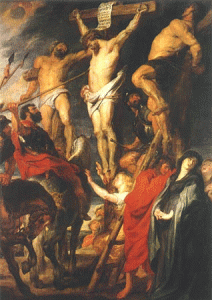
Here we have a 33 year old Jew covered in spittle and blood, stripped of His only possession – His cloak, His back pulped from flogging, His limbs pinned to a piece of wood, His body hoisted onto the upright, an accusation of blasphemy and sedition placarded above Him, His followers scattered, crowds hurling abuse, the sky black and heaven silent. And Jesus waits until this moment to cry out “I did it!”
That’s the meaning of “It is finished.” It’s a single Greek word that means ‘it is covered, it is satisfied, it is paid for.’ Archaeologists have found the word stamped across first century bills. When you made that last mortgage repayment to the building society, the final notice would come back with the stamp: ‘it’s paid for’, ‘it’s covered’, ‘you’ve done it!’
And in His final moments Jesus declares His death to be His victory: “It is finished!” Not ‘I am finished’. This is not a cry of defeat. ‘It is finished’. This is about accomplishment. But what exactly is being accomplished?
Well it’s an ancient work that was alluded to in the opening chapters of the Bible. In Genesis 2 we read about the conclusion of the creation week. At the end of the sixth day, “God rested.” The LORD brought creation to completion, that all might find rest in a true Sabbath.
Of course the fall puts a major spanner in the works. There is no longer any rest to be found in this old creation, only striving and failing. Therefore a new work of God is afoot.
Fast-forward to John chapter 5 and Jesus gives a sign of the new work. He brings new creation life to a lame man. Of course the authorities – guardians of the old order – are incensed that Jesus would “work” on the Sabbath. He replies:
“My Father worketh hitherto, and I work.” (John 5:17)
The Father and Son have not retired from world. Since the fall, the Father and Son have been working to redeem the old creation and bring it to its true rest.
This is the great work of God. This is the task which must be “finished” – the destruction of the old order, that new life might be raised up. And here on the cross we see it happening. The Son has become flesh. He has taken humanity to Himself and with it, the headship of this old order. He wraps our death, pain, struggle and curse around Himself so that He might put it into the ground like a seed. Then the world can be raised up – born again. (John 12:24)
Picture Him there on the cross. He is lifted up as the Head of this old order – shot through with sin, curse and death. He is a figure of disgust, truly summing up the hell of our plight. And now look at the time. It’s Friday afternoon – the end of the sixth day. Sabbath is closing in when no-one may work. And just in the nick of time, He shouts “Finished!”
His work is to die, to take this creaking world down into death and finish it off once and for all. On the sixth day, He accomplished His mission. On the Sabbath He rests. And on the Sunday, a whole new world begins.
Luke 23:44-49; John 19:28-30
– An old car that breaks down for the last time.
– A sports team that knows it can’t win.
– A business that finally calls it quits.
In all these situations we’d say they “gave up the ghost.”
In the bible, the phrase describes death. Abraham, Isaac and Jacob were all said to have “given up the ghost” when they died. It just means that they breathed their last breath.
In the biblical languages (and in old English), breath, spirit and ghost were all one word. And so for Abraham and others, it was a case of their body returning to dust and their spirit (or ‘ghost’) returning to God. (Ecclesiastes 12:7).
We’re all destined to give up the ghost. Death is “the way of all the earth” (1 Kings 2:2). And the funeral service has a stark reminder:
“earth to earth, ashes to ashes, dust to dust”
Our spirits animate us for a while, but soon we give up the ghost. And down to the dust we go.
I don’t know what you make of that song from the Lion King, “The circle of life”? It’s incredibly catchy, but I can’t sing it. When I realise that I am dust and I’m destined for the dustbin, I don’t feel like singing. Especially since the bible argues it’s more of a semi-circle really! If life naturally runs its course then we emerge from the cosmic compost heap only to sink back down to the sludge.
Just after Adam sinned the Lord told him:
“dust thou art, and unto dust shalt thou return.” (Genesis 3:19)
That’s the kind of life we’ve inherited from Adam. It’s not a life-cycle. It’s a one-way arrow pointing straight to the grave. And there’s no way out.
Our natural life – the life of the flesh – only produces more flesh. We can’t generate spiritual life from our own resources. We are perishing and one day we will all “give up the ghost.”
So what does the Son of God do when He sees His handiwork perishing? It should never cease to amaze us: He comes to perish too. Even the Word our Maker gives up the ghost. John was there at the cross to see it happen:
“Jesus said, It is finished: and he bowed his head, and gave up the ghost.” (John 19:30)
Here is the Lord of Glory going “the way of all the earth.” But why should the Author of life subject Himself to death?
Let’s hear the 4th century Bishop, Athanasius:
“For this purpose, then, the… Word of God entered our world. In one sense, indeed, He was not far from it before, for no part of creation had ever been without Him Who, while ever abiding in union with the Father, yet fills all things that are. But now He entered the world in a new way, stooping to our level in His love and Self-revealing to us. He saw the reasonable race, the race of men that, like Himself, expressed the Father’s Mind, wasting out of existence, and death reigning over all in corruption. He saw that corruption held us all the closer, because it was the penalty for the Transgression… All this He saw and, pitying our race, moved with compassion for our limitation, unable to endure that death should have the mastery, rather than that His creatures should perish and the work of His Father for us men come to nought, He took to Himself a body, a human body even as our own… because all our bodies were liable to the corruption of death, He surrendered His body to death instead of all, and offered it to the Father. This He did out of sheer love for us, so that in His death all might die, and the law of death thereby be abolished because, having fulfilled in His body that for which it was appointed, it was thereafter voided of its power for men. This He did that He might turn again to incorruption men who had turned back to corruption, and make them alive through death by the appropriation of His body and by the grace of His resurrection. Thus He would make death to disappear from them as utterly as straw from fire.”
When Jesus gave up the ghost it wasn’t a failure. On the contrary, as our verse declares, His death “finished” death for us all. It was the very accomplishment of His divine mission. More on this next time…