Putting words in his mouth

Exodus 4:1-17

Click for source

If you accuse me of putting words in your mouth you’re probably complaining that I’m misrepresenting your views.  Perhaps I have elaborated on your statement in a way you never intended.  “Stop putting words in my mouth,” you’ll say.

But the biblical origin of the phrase is a little different. In the Bible, Moses is meant to put words in his brother Aaron’s mouth.  And both Moses and Aaron are very happy about the whole arrangement.  You see Moses doesn’t want a podium or a microphone.  If he’s going to play any part in this whole Exodus caper he wants his brother to be his mouthpiece

This is quite understandable from a human viewpoint.  Moses’ last attempt at leading the Israelites was 40 years ago.  It was a failed coup and he’d spent the last four decades as a stranger in a strange land.  He’s not exactly brimming over with confidence:

Moses said unto God, Who am I, that I should go unto Pharaoh, and that I should bring forth the children of Israel out of Egypt?  (Exodus 3:11)

Moses is full of self-doubt.  So what does he need?

Well ask anyone today and they’ll tell you: the solution to self-doubt is self-confidence.  That’s the modern cure-all for whatever ails you.  Have more confidence in yourself!

That’s what the world says.  What does the LORD say?

I will be with thee  (Exodus 3:12)

There used to be a saying in tennis that the greatest doubles team imaginable was John McEnroe and anyone.  John McEnroe and anyone could win Wimbledon.

If you happened to be that anyone it would be absurd to spend the whole pre-match press-conference saying “Who am I to win a tennis match? Who am I to win Wimbledon?  I’m not a brilliant tennis player!”

What would John McEnroe say?  Apart from ‘You cannot be serious?’  He’d say, “I will be with you.  Enough about yourself, really it’s irrelevant.”

This is how the LORD seeks to address Moses’ self-doubt.  Not to instil self-confidence, but God-confidence.

Well Moses responds asking about the LORD’s identity.  And the LORD responds pronouncing His name: “I AM THAT I AM.”

Even if Moses’ self-confidence is flagging, His LORD knows who He is.  He’s strong enough to get the job done.

But Moses still has his doubts:

Moses answered and said, But, behold, they will not believe me, nor hearken unto my voice.  (Exodus 4:1)

Well, the LORD gives Moses three miraculous signs to authenticate his ministry.

But even this is not enough.

Moses said unto the LORD, O my Lord, I am not eloquent, neither heretofore, nor since thou hast spoken unto thy servant: but I am slow of speech, and of a slow tongue.  (Exodus 4:10)

If we were reasoning with Moses at this point we’d probably head in two directions.  We’d either give up in exasperation or we’d pander to his inverse pride: “Nonsense Moses, you have a lovely speaking voice I’m sure you’ll be just brilliant!”

But the LORD is different.  Again he seeks to take Moses’ eyes off himself:

And the LORD said unto him, Who hath made man’s mouth? (Exodus 4:11)

Which is harder, making a mouth or putting words in it?  If the LORD has done the hard thing, don’t we think he can do the easier thing too?

But Moses responds, effectively saying “Send someone else.”  (Exodus 4:13)

And the LORD is angry with him (v14).  Not for some failure of self-confidence, but for his failure of God-confidence.  Moses does not trust the LORD to do in him what He commands of him.

And so we come to our phrase for today.  The LORD brings up Aaron, Moses’ elder brother, and says to Moses:

thou shalt speak unto him, and put words in his mouth: and I will be with thy mouth, and with his mouth, and will teach you what ye shall do.  And he shall be thy spokesman unto the people:  (Exodus 4:15)

In this way the LORD redeems the situation.  In spite of Moses’ sin, the LORD will use this turn of events to reveal truth about Himself.

In verse 16 the LORD says that Moses will be like God to his brother.  This is because God addresses the people only and always through His Prophet, Jesus Christ (Acts 3:22-23).  God speaks through His Son the way Moses spoke through Aaron.

As Jesus says:

as my Father hath taught me, I speak these things.  (John 8:28)

all things that I have heard of my Father I have made known unto you.  (John 15:15)

When we hear the words of Jesus, He is not speaking on His own.  The grace and truth that drop from His lips are the words which the Father puts in His mouth.

And for all of us, do you lack confidence in the calling God has placed on your life?  Let this story teach you.  We mustn’t look within – we will only find reasons for doubt there.  Look out to Christ, He is the great I AM.  The Christian does not have self-confidence, we have Christ-confidence which is better by far!

A land flowing with milk and honey

Click for source

Exodus 3:14-22

Egypt was not a bad land.  In fact it was a very good land.  Genesis 13:10 describes it as “like the garden of the LORD”!  And under the wise and righteous rule of Joseph it had flourished, with the Israelites enjoying “the fat of the land.”

But since Joseph had been forgotten (Exodus 1:8) it was no longer a good land for the Israelites.  Instead, for the seed of Abraham, it was a “house of bondage” and a “furnace of affliction.” (Exodus 20:2; Deuteronomy 4:20; Isaiah 48:10).

Importantly, the hope for the Israelites was not a coup d’etat in which they seized control of Egypt.  Their hope lay beyond Egypt in a land that was promised to them before there was ever a seed of Abraham. (Genesis 12:7)

For Israel in slavery, home was a place they had never been.  But the description is held out to them again and again.  This promised land “flows with milk and honey.”  It’s a word for “gushing forth abundantly” and the verb is used with this phrase 20 times in the Old Testament.  In that context it only ever to refer to Canaan – the promised land.

Under the curse, Adam was told that the ground would produce thorns and thistles for him (Genesis 3:18).  But by faith, the seed of Abraham awaited a land that would bubble over with luxury goods. There would be no more scrounging for the bare necessities.  There would be nothing mean or plain about the land – it would overflow with fatness and sweetness.

Milk and honey are put together in only one other context in the Bible – when the bride belongs to the bridegroom (Song of Solomon 4:11; 5:1).  That richness of rest and enjoyment is an experience of “milk and honey.”

We all long for this homeland – a future resting place we’ve never yet experienced.  But we won’t get this by moving to Jerusalem.  Not even Abraham found this rest by dwelling in Canaan.  But as the book of Hebrews explains:

By faith he sojourned in the land of promise, as in a strange country, dwelling in tabernacles with Isaac and Jacob, the heirs with him of the same promise: For he looked for a city which hath foundations, whose builder and maker is God.  (Hebrews 11:9-10)

That small strip of land at the end of the Mediterranean was never the point. It was always a token of a far greater inheritance.  We, along with Abraham, look to “a better country” (Hebrews 11:16).  We look to the whole world set to rights when its true Joseph – King Jesus – stands upon it to rule in wisdom and righteousness.

For now we are sojourners in a land not our own.  But one day soon this earth will be resurrected and renewed, just as Jesus Himself was.  And we will be settled in the land.  Thorns and thistles will give way to milk and honey.

I AM THAT I AM

Click for source

Exodus 3:7-14

Recently Reebok ran an advertising campaign with the slogan “I am what I am.”  I wonder whether they knew they were ‘taking the LORD’s name in vain’?

But actually, anyone who says “I am what I am” must be aware of what a divine pronouncement they’ve uttered.  They are giving a final word on their own identity.  They are who they say they are and that’s that.

When the LORD of the burning bush says “I am that I am” it’s in response to a question from Moses.  He’s worried about what will happen when he goes to his people with a story about a burning bush and a promised deliverance:

[When] they say to me, What is his name?  What shall I say unto them? (Exodus 3:13)

And so the LORD answers

I AM THAT I AM: and he said, Thus shall you say unto the children of Israel, I AM hath sent me to you. (v14)

You could translate it in either the present or future tense (you could say “I WILL BE WHAT I WILL BE.”)  But this is the name by which He wants to be known.  And it’s a name preserved for us in the Hebrew name “Yahweh.”  Essentially if you write “I AM THAT I AM” in Hebrew and then squash down the letters you end up with “Yahweh.” And when it’s anglicized we might say “Jehovah”.  In our Bible translations it’s indicated by the word “LORD” when all the letters are capitals.  Every time you see “LORD” – over 6000 times in the Old Testament – it’s the personal name of this One from the burning bush: “I AM THAT I AM.”

This is the LORD naming Himself.  But what does it mean?

Well first of all, the LORD is taking the job of identifying Himself into His own hands.  He’s ending the game we like to play when we say “I like to think about God like this…”  God is who He is, not who we say He is.  He names Himself, we don’t name Him.  The direction of travel is always down.  From Him to us.

Thus, we are released from the prison of our own imaginations about God.  We don’t have to come up with God – He comes out with Himself.  He’ll define Himself in His way.

But that doesn’t mean He’s keeping Himself to Himself.  “I AM THAT I AM” is not about His splendid isolation.  How could it be?  Think of the One who utters it.  He is the Angel of the LORD (verse 2).  He is the One Sent from the Unseen God.  He is the eternal Son of the Father.  This is not the name of a lonely monad defining Himself in stark opposition.

Think of where He is pronouncing the name from.  A burning bush – symbolising His presence with the people in their suffering.

And think of the context.  Just two verses earlier He has used the same phrase “I AM / I WILL BE…” in a promise of tremendous solidarity:

And he said, Certainly I will be with thee (Exodus 3:12)

In a sense the LORD’s name in verse 14 is saying,

I will tell you who I am.  I will end the guessing games.  I AM who I WILL BE in my mighty saving acts.  You want to know who I am?  Watch this space.  Watch how I am with you.  Watch how I will deliver you.  Watch as I work unlike any other god or any other human – in glorious redeeming love.”

And if we really want to know the ins and outs of this name, we have to wait and see – not only what He does in the Exodus, but what He does 1500 years later.  In the fullness of time, He stands before His people again and says:

“I AM the Bread of life” (John 6:35);

“I AM the Light of the world” (John 8:12);

“I AM the Gate” by which you must enter (John 10:9);

“I AM the Good Shepherd” (John 10:11);

“I AM the Resurrection and the Life” (John 11:25);

“I AM the Way, the Truth and the Life” (John 14:6);

“I AM the True Vine” (John 15:1).

When we proclaim loudly who we are, it is to distance ourselves from the claims of others.  When Jesus does it He puts Himself – sovereignly – at our disposal.

What do you need to get through today?  How will the great I AM meet your needs?

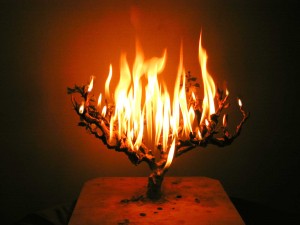
Burning bush

Exodus 3:1-6

Click for source

Usually when we talk of a “burning bush experience” we mean a divine encounter of grand proportions.  A happening so earth-shattering it awakens you to spiritual realities.

Yet, when you think about it, a burning bush isn’t the most arresting vision conceivable.  In fact for the director of Exodus the Movie, the special effects required for “the burning bush scene” would be the very least of their worries.  That’s easy compared to magic staffs, miraculous plagues, thundering mountains and Red Sea crossings.

So why the blazing shrubbery?  Is this really the best launch event for the Exodus?  Surely the LORD’s PR company could do better than this, especially considering the budget available!

But no.  Once we understand the symbolism, a burning bush is the most appropriate context for the LORD’s appearance.

Here is how the event unfolds.  Our stranger in a strange land – Moses – was doing what he’d done for the last 40 years: shepherding dumb animals through the wilderness.  He came with his flock to mount Horeb (a.k.a Sinai)…

And the angel of the LORD appeared unto him in a flame of fire out of the midst of a bush: and he looked, and, behold, the bush burned with fire, and the bush was not consumed. And Moses said, I will now turn aside, and see this great sight, why the bush is not burnt.  (Exodus 3:2)

There are three elements here: the bush, the burning and the One in the midst of the bush.

First, the bush.

Many times in the Bible, people are described as like a plant: a vine or a branch or a tree. Usually it’s the people of God en masse who are described like that, or their king is described like that since he sums them up as their representative.  And so you get Jesus saying to His people “I am the vine, you are the branches.”  (John 15:5)  The people of God are a plant grafted into the True Life-Source, Jesus.  So the bush represents the people of God.

Second, the burning.

Many times the suffering of the Israelites in Egypt is described like a furnace (Deuteronomy 4:20; 1 Kings 8:51; Jeremiah 11:4).  It’s a furnace of affliction.

Well here is a bush that is burning.  Burning, but not consumed.  And, wonder of wonders, the Angel of the LORD comes down into the burning bush.

That’s the third element: The One dwelling in the midst of the bush.

But who is He? Well you might know the story of another blazing furnace…

In the book of Daniel we read about a foreign king who throws three faithful Israelites into a “burning fiery furnace.” But when the king looks into the furnace he says this:

Lo I see four men loose, walking in the midst of the fire, and they have no hurt; and the form of the fourth is like the Son of God.  (Daniel 3:25)

This fourth figure looks for all the world like the Son of God.

And when the king releases the three men he says,

“Praise be to the God of Shadrach, Meshach and Abednego, who has sent his angel and rescued his servants!”  (Daniel 3:28)

The fourth figure was God’s Angel.  He’s the very same one who meets Moses in the burning bush – the Angel of the LORD.  Literally that means “The Sent One from the LORD.”  He is the Son of God.  And it is always His nature to come down into the fires to be with His people.

This is why the burning bush is such an appropriate apparition.  How should the good LORD meet with a suffering world?  Incredibly He joins us in the furnace.

In Exodus, the Divine Angel comes down to be with His people to lead them out.  But in the definitive deliverance, He would descend not just to a burning bush but would enter into our humanity for all time.  He would enter our predicament, take our sorrows and sufferings on Himself and then, on the cross, would take our sins on Himself.  There He endured the flames that were destined for us.

And so the Christian can look to Christ crucified and from the midst of His fiery affliction we can hear Him say what He said to Moses:

I have surely seen your affliction, and have heard your cry … I know your sorrows; And I have come down to deliver you.  (cf. Exodus 3:7-8)

What do you think of when you imagine a divine encounter?  A special effects set-piece?  No.  The “great sight” which should astonish the world is this: God sends His Son down into a burning bush, down into the afflictions of His people, down to a bloody cross.  We should all “turn aside” and be amazed, not simply at a God above us or over us.  But a God who shows up in the furnace, to be God with us and for us.

In all their affliction God was afflicted, and the Angel of his Presence saved them: in his love and in his pity he redeemed them; and he bare them, and carried them all the days of old.  (Isaiah 63:9)

Reading Between the Lines / King’s English Catch Up

You might have noticed a break in communications here recently. I’ve been working hard on Reading Between the Lines, a daily devotional based on the King’s English. In these videos I update the King’s English entries, using a modern translation and make it available on YouTube and as a Podcast and Vodcast.

Subscribe here.

Below, please find the King’s English posts that failed to post so far in February:

 Olive branch

Rainbow

Tower of Babel

Abraham

Fear not

Covenant

Circumcision

Sodom and Gomorrah

Fire and brimstone

Test of faith

Coat of many colours

Fat of the land

A stranger in a strange land

Exodus 2:11-25

Click for source

Exhausted, the freedom fighter slumped by a well.  He had taken a risk, initiating a violent coup.  But now he’s a failed revolutionary without a friend in the world.  A week earlier he had been a prince in the most powerful court on earth.  Now, aged 40, he’s Egypt’s most wanted man.

Moses’ story to date has been an extraordinary tale of rags to riches.  He was born a Hebrew – a member of Joseph’s race.  But Joseph was now long dead and in the next 400 years there was a chillingly familiar progression.  The Jews were first oppressed, then enslaved and finally the labour camps turned to genocide.  Pharaoh had ordered all Israelite boys to be drowned at birth (Exodus 1:11, 22).

But this child was saved.  Instead of being hurled into a watery grave, he was cast off by his mother in a miniature ark (Exodus 2:3) and “saved” out of water.  And that’s what Moses means: “saved” (Exodus 2:10).

In an ironic twist, the child was saved by Pharaoh’s own daughter who then employed Moses’ birth-mother to raise him.  His mother’s experience must have been a real death and resurrection.  She had cast him off on the waters, received him back and was then paid to raise him! (Exodus 2:9)

By his natural mother he would have learnt the stories of Israel.  Stories about Abraham and the promises to his seed.  Stories of how Israel was destined to suffer in Egypt for 400 years.  And that afterwards they’d be saved through a mighty work of God (Genesis 15:13-14).

By his adoptive family he was growing in the wealth and power of Egypt, learning their ancient wisdom and ways. (Acts 7:22)

By the age of 40 he was at the height of his physical and political powers.

And the reader is thinking – “I know how the story goes.  Surely Moses will climb through the ranks of the Egyptian court and, through political cunning or military might, he will liberate his people as an inside job.”

Well, maybe that’s what Moses was thinking.  But that plan goes horribly wrong.

In Exodus 2:11 he makes a ham-fisted attempt at liberation.  One day he comes to the rescue of a fellow Israelite against his Egyptian slave master.  Moses kills the Egyptian.  In Acts chapter 7 we learn that this was meant to be the first act in an uprising of the slaves.  But the Israelites aren’t on board with Moses at all (Exodus 2:14).  The coup is well and truly botched, Pharaoh is alerted and Moses flees into the desert – on the run from the authorities, on the run from his own people.

And so he collapses by the well in wilderness country.  As Acts 7 tells us, he lives out the next 40 years as an insignificant shepherd.

Can you imagine the regrets, day after day?  If Moses was anything like me he’d be complaining, “How can this be used by God?  Shepherding stupid creatures around the wilderness for 40 years?  What possible good could this serve?”

Clearly Moses is feeling sidelined by life.  When he has a son he calls him “Gershom” meaning “stranger”.  He gives the reason in v22,

I have been a stranger in a strange land.

This is the context of God’s mighty deliverance.  Exodus will be the story of God’s salvation.  He doesn’t use a political insider or a popular freedom fighter.  He uses a despised, octogenarian shepherd.

The leader through whom God will bring salvation is brought low – just as low as his battered people.  But the depths are exactly where God loves to work.

As D.L. Moody, once commented:

“Moses spent 40 years thinking he was a somebody, 40 years realizing he was a nobody, then 40 years seeing what God can do with somebody who knows they’re a nobody.”

40 days and 40 nights

Genesis 7:1-24

Click for source

In the “film” 40 days and 40 nights Josh Hartnett has to endure this “unbearable” trial period without sex.  It’s a time of dreadful testing and I’m sure hilarity ensures.  I wouldn’t know, I couldn’t be forced to watch it – even for research purposes.

But we seem to have a cultural memory that “40 days and 40 nights” is a trying time.

Lent of course is 40 days (actually the whole time is 46 days but not even monks fast on Sundays so you get those off).

There are seven prominent periods of 40 days in the Bible.

The first “40 days” was the time of the flood-waters that fell in judgement on the earth.  (Genesis 7:4)

Moses fasted 40 days on the mountaintop before entering God’s presence.

Israel sent 12 men to spy out the land of Canaan.  They spent 40 days doing reconnaissance of the promised land.

Goliath taunted Israel for 40 days before David stepped forward to bring victory.

Jonah came to Nineveh with a message – in 40 days the city would be destroyed.  But, because they repented, God visited not with judgement but with salvation.

For 40 days Jesus entered the desert (a place of trials and temptations) and emerged victorious.

Finally, there were 40 days between Jesus’ resurrection and the time of His ascension to heaven.  It was a time when He proved Himself to His followers, showing them tokens of the resurrection life He promises to all.

40 days seems to be a time of testing and transition.  For those who pass the test there is a new world to enjoy:

A world washed clean.

Face to face with the LORD.

A land of milk and honey.

Victory over the enemy.

Salvation.

The defeat of the devil.

The new creation.

But the flood story tells us this – we can’t endure the test by ourselves.  The salvation beyond judgement is for one person only.  It is the ultimate Noah, the ultimate Moses, the ultimate David – Christ – who endures on our behalf.   Those who trust Him are hidden with Him, the way the Ark’s passengers were hidden with Noah.  But, on the other side, we benefit from His victory.

None of us can pass the ultimate test.  We cannot transition to the ultimate destination.  But Jesus Christ has.  He has crushed the devil and defeated sin and death.  He has made it to the throne of heaven and offers us new life if we simply hide ourselves in Him.  For now there is testing: “Do not be surprised at the painful trial you are suffering” (1 Peter 4;12).  But beyond these “40 days” our Saviour will bring us to rest.

Two by two

Genesis 6:1-22

Click for source

It’s the name of countless nurseries and toddler groups.  We instantly think of a cramped menagerie and a cartoon boat – usually absent Noah and the family.  Also absent is any hint that this is a cataclysmic scene of judgement.

The context is Genesis 6.  Apparently the “sons of God” were uniting with the daughters of men (“sons of God” is most commonly a reference to angels in the Bible).  It was one more illicit alliance between earth and heaven.

From the beginning, there has been only one legitimate alliance of heaven and earth.  As Genesis 3:15 promises – the Man of Heaven will become the Man of dust.  Notice the trajectory.  The Man of Heaven will come down.  Only in covenant relationship with the God-Man will we have the union we seek.  But we’re always seeking illegitimate alliances.

In Genesis 3 Satan offered the original anti-God union of angels and men.  And this kind of coup – evident in Genesis 6 – would be repeated in Genesis 11 when earth would again seek union with heaven – under its own steam and on its own terms.

But the LORD is implacably opposed to all these attempts for they all pervert a world that was made by Christ and for Christ.

The fruit of this adultery is terrible.  In Genesis 6:5 we read the LORD’s assessment of a world corrupted through spiritual infidelity:

And GOD saw that the wickedness of man was great in the earth, and that every imagination of the thoughts of his heart was only evil continually.  (Genesis 6:5)

Not just the thoughts of the heart – the imagination of the thoughts of the heart.  Every one of them.  Not just occasionally evil, continually evil.  Not partially evil, only evil.

It’s a problem that begins with spiritual adultery.  It infects the heart then spreads out.  Later in the chapter the LORD looks and sees “the earth is filled with violence” (v11 and 13).  From the wicked heart to the clenched first the world becomes “corrupt” (v11,12) – that is, perverted, twisted, polluted, marred.

Spiritually-adulterous, black-hearted and violent.  We read these assessments as though of course God’s going to have it in for us.  Of course He’ll be negative.  And of course He’s over-reacting.  We think like the angsty teenager complaining about their history teacher “He hates me.”

But the LORD is not like that.  He loves His world.  He made us for Christ, for eternal friendship in bonds of covenant love.  He’s no kill-joy or pessimist.  That’s what makes this assessment so sobering.  The LORD is angry – furiously angry – with a world He loves.

In fact He’s sorry He made it:

It repented the LORD that he had made man on the earth, and it grieved him at his heart. And the LORD said, I will destroy man whom I have created from the face of the earth; both man, and beast, and the creeping thing, and the fowls of the air; for it repenteth me that I have made them.  (Genesis 6:6-7)

God is sorry He made us!  And in His wrath He will destroy the earth.  We are a long way from the cartoon images here.  Starting with man at the head, there will be a cosmic judgement.

This sounds like He’s going back on everything He ever began.  It sounds like the whole creation project is going in the bin.  But then there’s our phrase: “two by two.”

There will be a place of saftey – the ark.  And the people who hide with Noah will survive.  This will amount to his wife and his three sons with their wives (two by two if you like).  And the animals who hide with Noah will survive.  And not just survive.  They also are coupled up.  Male and female – to start again.

Noah doesn’t just preserve specimens on the ark, he hides couples with him.  They come “two by two” (Genesis 7:9,15).  Because judgement is not the end.  It’s the beginning of new life beyond judgement.  There will be a whole new world after the end of the world.

Repeatedly the Bible points to the flood as a pattern for this world’s judgement at the end.  And here’s what we learn: the key is not to avoid judgement.  The world will be washed clean.  The key is to be hidden with the one called Rest.  And when you come to Him there will be a fruitful future beyond death and wrath.

Noah

Genesis 5:28-32

Click for source

When you think of rest, what springs to mind?  If you’re like me you’ll be thinking about an absence of stresses and suffering.

The name “Noah” means rest.  But the one called Rest does not come in the context of peace and safety.  It was in the midst of death and curse that the promised child was born.

“Lamech lived an hundred eighty and two years, and begat a son: 29 And he called his name Noah, saying, This same shall comfort us concerning our work and toil of our hands, because of the ground which the LORD hath cursed.”  (Genesis 5:28-29)

Lamech was very aware that the whole creation is groaning under divine judgement.  The world is “rigged for frustration” as one writer has put it.

And it’s still rigged for frustration.  The curse is all around us in broken lives, broken relationships.  A broken world.

What do we do about that?  We might pretend that the curse is not really so bad.  We might whistle through the grave-yard to keep up our spirits.  We might despair and settle down in the rubble to await the inevitable.  We might trust to our wealth and resourcefulness to side-step the curse.

But Lamech does something different.  He doesn’t minimize the awfulness of a broken world – he acknowledges the work and toil, the death and curse.  He doesn’t pretend to master the situation out of his own resources.  And he doesn’t resign himself to the chaos.

Instead Lamech looks the darkness in the eye, but with a defiant ‘nevertheless’ he believes in rest and peace.  And so he names his boy “Rest.”

Lamech, like Adam and Eve before him, looked expectantly to his offspring in the light of that original promise of Christ (Genesis 3:15).  Christ would be the ultimate answer to the darkness, and so His people anticipated His coming eagerly.

Eve wanted her first offspring to be the One.  But she gave birth to an anti-christ figure in Cain – a perverse firstborn who kills and so furthers the curse.

Lamech’s offspring is different, but will point to the Messiah in his own way.  Noah is not the Christ but he is a christ-figure.  This one called “Rest” would save the world through judgement.  And all who would seek peace on the far side of judgement would seek refuge in him.

Here we see the way that true rest comes.  Not apart from the curse but through it, in fact through cosmic judgement.  Salvation means finding safety.  It means looking to the Peacemaker and being hidden with Him.

In this way we will find rest.  Not by making peace with this broken world.  Not by diminishing our hopes for wholeness and life.  But by looking through the toil and death around us.  In fact looking through the coming judgement which will cleanse the world.  We look to true and eternal rest on the other side of judgement because we look to Christ and hide in Him.

Methuselah

Genesis 5:18-27

Click for source

If someone calls you ‘Methuselah’ it’s probably not a compliment.  He was 969 years old when he died – the oldest man in the Bible.

In the midst of the avalanche of deaths in Genesis 5, Methuselah weathers the storm better than most.  But actually someone else in the family tree does better than Methuselah – his dad in fact.  When Methuselah was a spritely 300 years old, this happened:

Enoch was not; for God took him. (Genesis 5:24)

And the explanation?

Enoch walked with God.

Methuselah’s grandson is described similarly – Noah too “walked with God.”  And both Enoch in Genesis 5 and Noah in Genesis 6 escaped the death sentence that swept the others away.  They walked with God and found grace and salvation.  They found an answer to death.

Most people today, if they want to escape the ravages of age, do so through diet and exercise.  Some go to more drastic lengths.  Perhaps surgery and injections.  Some even want their corpses frozen to be defrosted when we’ve found death’s cure.  And transhumanism hopes to eliminate ageing and death altogether.

The Bible gives us an answer to death that is older than Methuselah.  Walk with God – the same God who walked with Adam and Eve in the garden.  The same God who walked among us as Man and defeated death on our behalf.  Walk with Christ and He will walk you through death.

The grave is too powerful for us.  It will swallow us.  But Christ is more powerful still.  He swallows up death:

Death is swallowed up in victory.  O death, where is thy sting? O grave, where is thy victory?  The sting of death is sin; and the strength of sin is the law. But thanks be to God, which giveth us the victory through our Lord Jesus Christ.   (1 Corinthians 15:54-57)